Cultural Insights

Inshallah: What Does It Really Mean?!

Have you ever heard the word inshallah or inshalla (انشاالله)? Maybe you’ve even wondered what it meant? In this article, we’ll cover all the definitions – both literal and contextual – so you can use the word inshalla like a native Arabic speaker! 

First and foremost, the literal definition of Inshalla (انشاالله) is “If God wills [It].” This is a commonplace shortened, casual, and slightly less religious variation of the word inshaAllah (إِن شَاء اَللّٰه), which is pronounced with one more syllable (“In-sha-Al-lah”) and used in more religious contexts. 

The word is often assumed to only be spoken by Muslims, but this is a common misconception! Inshalla is actually used by Arab-speaking and Arab-influenced people of all faiths and beliefs from every corner of the world. For example, you can find this word spoken by Coptic Christian Egyptians, multicultural Kurds, secular Turks, Muslim Indonesians, Zoroastrian Persians, and many other communities!

Each community has added its specific touch to the pronunciation; it is common to hear Kurds and Iranians use the term less religiously by pronouncing it as ishalla (ایشالا) without the n and, again, dropping the stress of the last syllable. As you can see, this word is actually used by non-Muslim and secular people across the world!

Because so many people from different backgrounds, beliefs and origins use this word, there are a lot of different transliterations for it! Whether it be enshalla, enchalla, inchallah, nchallah, you will most likely encounter انشاالله in a myriad of different forms!

The word has even found its way into Spanish – “Ojalá.” This borrowing also means “God willing” or “hopefully” and entered the Indo-European language during the period of Muslim rule of the Iberian Peninsula, known as Al-Andalus.

Now that we have established the structure of the word and who uses it, what does it actually mean? Alas, there is no single answer! Inshalla is employed in a variety of circumstances to convey affirmation, hope, prayer, exceptions, and even polite disagreement. Confused? Have no fear! We’ll cover all the basics and –  inshalla – you will feel more confident by the end of the article.

1. “Yes, I hope so, too”

In the most basic sense, inshalla is a form of genuine agreement with something that was expressed, especially about a future event.

Eg. A: I hope we pass our exam day! B: Inshalla!

2. “Yes, and I’m praying for it too..”

The second basic use emphasizes that although you agree, it’s contingent upon divine will. In some devout communities, people are advised that since only God knows what will happen in the future, they should stay away from making definite statements about the future. Therefore, inshalla replaces “Yes!” You’re saying you wish the event happens, but as it’s not (entirely) in your hands, you can only speculate and pray.

Eg. A: I hope the weather is good tomorrow, I would love to have a picnic on the beach. B: Inshalla!

3. “Yes, okay (respectfully)!”

Inshalla can also simply be a respectful way to say “yes” and acknowledge you hear and understand what the other person said and you’ll do what they asked. This is especially common between older and younger family members!

Eg. A: You really need to clean your room today. B: I’ll get to it as soon as I can, inshalla.

4. “No… (but we’ll see if God wills it)”

Modern uses of inshalla can also be sarcastic. You can use the word to mean that you have no interest in making something happen, but “Yeah, sure, we’ll see if God or fate makes it happen.” This use is a well-known pet-peeve for many who grew up in Arabic-speaking homes!

Eg. A: Mom, can I please go to the beach tomorrow with my friends? B: Inshalla.

5. “We’ll see… but it’s probably not gonna happen…”

Inshalla can also be a form of disagreement or procrastination, an outright “Nope, never gonna happen.” How do you know this is the case? It’s all about understanding the dynamic between you and the person you’re speaking with and feeling the context. You’ll get better with practice! 

Alternatively, you’re signaling you hear what the person is saying, but you’re also probably not going to do what they asked out of laziness, limited capacity, or other internal conditions that limit your motivation.

Eg. A: Mom! Can we go get ice cream today? B: Yeah, inshalla, we’ll see…

6. “It’s going to take a while and I don’t have much information.”

This last use is related to the former, but expanded slightly in scope. Basically, the limiting condition is not only an internal state but also external circumstances. This vague answer can be frustrating to hear, but hopefully a better understanding of the cultural nuances and language will help you figure out a positive path forward.  

Eg. A: When will the documents be ready? B: In a week inshalla.

A: Okay, it’s been a week, are they ready? B: No, in a few days inshalla.

A: Fine, It’s been several days. What about now? B: Inshalla tomorrow!

So there you have it — the affirmative, the sarcastic, the hopeful, and the negative. Like many words in Arabic, inshalla, is vivid and dynamic. An understanding of cultural nuances and context will make a world of difference when you’re trying to navigate what the speaker really means.

With NaTakallam, native-speaking language partners from displaced backgrounds will guide you through the ins and outs of the Arabic language and culture and their experiences in the Arab world. Don’t stop here, keep learning with us in one of our 6 Arabic dialects here! We offer Levantine Syrian, Levantine Lebanese, Levantine Palestinian, Yemeni, Egyptian, Iraqi, and also Modern Standard Arabic! 

Inshallah: What Does It Really Mean?! Read More »
10 Common Misconceptions About Refugees | NaTakallam

10 Common Misconceptions About Refugees


Myth 1: Most refugees restart their lives comfortably in new countries.

Fact: Less than 1% of refugees are resettled into new countries.


Resettlement is still a rare phenomenon, even though millions are eligible. In 2020, resettlement numbers hit a record low in the past two decades, according to a UNHCR report. Even though the US increased their refugee ceiling in 2021 to 62,500, a total of only 11,411 were resettled in the fiscal year – a mere 18% of the announced target. Even if successful, the resettlement process often takes years, and the journey of starting life anew in a foreign country can be extremely hard, especially in the face of new legal and educational systems, foreign languages, and cultural norms. 

NaTakallam works with skilled refugees who are often stuck in limbo, cut off from local labor markets, in camps or other transit circumstances. Therefore, each language session with NaTakallam makes important and meaningful contributions to their livelihoods and overall sense of belonging.

Sources: UN, UNHCR (Report), UNHCR (Data finder), Immigration Forum.


Myth 2: Most displaced persons flee to the US, Europe and Australia
.


Fact: 75% of displaced persons are hosted in developing countries.


Contrary to common belief and misleading headlines, only a small fraction of resettled refugees are hosted in developed countries of the West. From the 108.4 million forcibly displaced people today, the US admitted just over 25,000 refugees in 2022, using only 20% of the admissions target set by the Biden administration. In 2022, the EU resettled only 16,695 refugees despite promising to resettle more than 20,000 refugees. Most are forced into limbo states, with no legal residency or work status. 

The majority of displaced persons that NaTakallam works with have fled to neighboring developing countries. As of the end of 2023, the leading host countries include Iran (3.8 million refugees), Turkey (3.3 million), Colombia (2.9 million), Germany (2.6 million) and Pakistan (2 million). Together, they accommodate 39% of the global refugee population.

Sources: UNHCR, Amnesty, Immigration Forum, CBC News, International Rescue Committee


Myth 3: Most refugees are adults.


Fact: Over 40% of refugees are under 18.


Not all refugees are adults. According to the UNHCR, an estimated 36.5 million of the world’s 100 million displaced people are under the age of 18. Furthermore, an estimated 12.5 million of the 27.1 million refugees are child refugees. Between 2018 and 2020, an average of between 290,000 and 340,000 children were born into a refugee life per year. Today, there are over 1 million children in the world who were born as refugees.

This demographic breakdown holds true for almost every regional crisis. Though children make up about a third of the global population, they constitute 40% of the world’s refugees. This dynamic is a significant concern, as contemporary child migration is often inhumane, unregulated, and dangerous. Moreover, an additional obstacle for refugee children seeking asylum is the fact that many of them go through this process without adult support. 

Source(s): UNHCR, UNICEF, Concern USA, UN News


Myth 4: Many refugees have smartphones so they must be well off.


Fact: Smartphones are a lifeline for refugees, not a luxury.


For refugees, smartphones provide access to essential and potentially life-saving information. Smartphones are used to find food, shelter, and assistance, navigate new areas, communicate with loved ones, and even earn a living through virtual work. Refugees often spend up to a third of their disposable income to afford connectivity and opportunities that come with a smartphone, according to Amnesty International.

In the era of what some have dubbed “the connected refugee,” NaTakallam provides opportunities for refugees to work as online language tutors, interpreters, and translators for users worldwide. 

Sources: UNHCR, Forbes, GSMA, Amnesty 


Myth 5: Most refugees live in camps.


Fact: Over 60% of refugees live in urban areas.


 Contrary to the frequent images of sprawling refugee camps in the media, over 60% of refugees and more than 80% of Internally Displaced Persons (IDPs) live in urban areas. This has presented a new set of challenges: resources are often less concentrated and humanitarian assistance is less plentiful, meaning that individuals can miss vital information and aid more easily.

NaTakallam works with displaced persons in both urban areas and refugee camps to ensure no one is marginalized due to their current circumstances. We leverage technology in a way that ensures accessibility for all users. 

Sources: UN Refugees, UNHCR, The Brookings Institute 


Myth 6: Refugee influxes ruin economies and communities.


Fact: Studies show that refugees can have positive fiscal and social impacts.


The notion that admitting refugees will ruin a host country’s economy is rooted in false economic beliefs. Over time, it has been shown that refugees actually add more value to the economy than the initial cost of resettlement – if they are granted the right to work legally. Moreover, studies show that low-skilled foreign workers and low-skilled domestic workers tend to complement each other rather than compete. In the US, refugees add billions to the economy, and experts assert that they will play a vital role in helping economies recover after the pandemic.

What is more, contrary to political narratives, studies consistently show that refugees are less likely to commit crimes, engage in “antisocial” behavior, or be arrested. In fact, higher immigration is generally associated with much lower crime rates. 

Many of NaTakallam’s displaced tutors are barred from local employment due to legal restrictions – leaving them vulnerable to the black market and unsafe work. NaTakallam allows refugees to make an income legitimately and safely, regardless of their location.

Sources: Immigration Forum, University of Oxford, Business Insider, Economic Research Forum, Global Citizen


Myth 7: Most refugees are from the MENA region.


Fact: The largest groups of refugees are from Afghanistan, Syria and Venezuela.


While the news is often inundated with talk about refugees from the Middle East and North Africa region, over 72% of refugees arriving in the United States are actually not from the MENA region. As of 2022, the conflict and humanitarian crisis in Ukraine has forced more than 8.2 million people to flee the country with 5.9 million internally displaced. Followed by 5.4 million Syrian refugees hosted within the MENA region, with over 6.8 million internally displaced, and 5.2 million refugees from Afghanistan, of which 47% are children, and 3.3 million internally displaced. Furthermore, countries such as Venezuela, Burkina Faso, Myanmar, and Eritrea, among many more, are grappling with conflict and displacement issues, yet are frequently overlooked.

Sources: UNHCR, UNHCR Syria, UNHCR Afghanistan, UNHCR Ukraine, Statista, NRC


Myth 8: Refugees never return home to their native countries.


Fact: Most refugees would prefer to go home, and many do.


Popular narratives paint refugees as “economic migrants” who come to profit from the opportunities of more developed countries and never return to their home countries. This is a misconception. According to various surveys done across the world, most refugees are understandably reluctant to go home when the situation remains unsafe. However, from a sample survey of 1,100 displaced Syrians, an overwhelming majority, around 73%, say they would return home if the conditions were right.

Another report showed that in 2019 alone, 46,500 refugees voluntarily returned to the Central African Republic. What refugees seek is physical safety, dependable work, and sustainable housing, and the majority agree that if this were available in their home country, they would return. NaTakallam enables refugees to have reliable, consistent work as language tutors and translators in Arabic, Armenian, English, French, Kurdish, Persian, Russian, Spanish, Ukrainian and more.

Sources: UN refugee statistics, Washington Post, Relief Web, The National, UNHCR report


Myth 9: Refugees don’t make for good employees.


Fact: Refugees can be a long-term economic advantage for companies.


Employers say it best: when it comes to refugees, “they come to work and get the job done.” Research from the Fiscal Policy Institute (FPI) in 2018 highlights that in addition to being hardworking, refugees often stay with their employers for longer and speak a foreign language – a highly desirable skill for any global company. 

Furthermore, in a Tent Partnership for Refugees report (also backed by the FPI), many businesses that hired refugees stated that they were among their most dedicated workers. Employee turnover rates were much lower among refugee employees than in the general population – thus, saving businesses money. 

Sources: UN, Fiscal Policy Institute, Business Insider, Tent Partnership for Refugees.


Myth 10: “There’s nothing I can do to help refugees.”


Fact: Each person can make a difference in supporting refugees.


Everyone can do something. Whether it is welcoming refugees into your own community, raising awareness about the cause, or supporting refugee-centered organizations, you have the power to make an impact beyond donations.

And if you are looking to support refugee livelihoods directly, amidst the fastest-growing displacement crisis of our time, consider bringing NaTakallam into your home, classroom, or office setting for your language-learning, cultural exchange, or translation needs. Change a life, one refugee at a time.


10 Common Misconceptions About Refugees Read More »

NaTakallam 6 Must-Try Easter Delicacies From Around The World

6 Must-Try Easter Delicacies From Around The World

Easter is celebrated by millions around the world and it is not a surprise that food is at the heart of these festivities. Join us as we delve into the Easter delicacies from around the world – from Ukraine to Argentina, Armenia to Egypt.

Paska (пáска)1. Paska (Ukraine)


Paska
(пáска) is a bread traditionally made at Easter in Ukraine and other parts of Eastern Europe. It is made with milk, butter, eggs, flour and sugar. In Ukraine, it forms an important part of the Easter basket also known as the “basket of blessed food” (свячене, “svyachene”) alongside Easter eggs (писанки, “pysanky”) and sausage (ковбаса, “kovbasa”).

Variations of this bread are also made in Armenian and Assyrian communities of Iran, Iraq, Armenia and the diaspora.

Kaek and Ma’amoul2. Kaek and Ma’amoul (Egypt and the Levant)


Kaek (كعك) and Ma’amoul (معمول) are two cookies at the heart of all Egyptian and Levantine celebrations (read about ma’amoul in our Ramadan blog). These cookies are made with semolina flour and butter. They are stuffed with dates, pistachios, walnuts and flavoured with rosewater, orange blossom, mastic and mahlab. Each cookie is formed by hand or by using wooden moulds and each shape symbolizes an event associated with the Holy Week and Easter.


Egyptian Fattah3. Fattah (Egypt)


Among the Coptic Christians of Egypt,
fattah (فتّة) is a popular dish eaten at Easter and other feasts. It is a quintessentially Egyptian dish that dates back to the time of the pharaohs. It is made with rice, (lots of) garlic, crispy pita bread and a protein of choice – commonly, lamb. 

The word fatteh comes from the Arabic root verb meaning “to break up” or “crush”, referring to the pita bread crumbs that form the bases of all fatteh recipes. 

A similar but distinct dish is found in southern Levant. This Levantine counterpart (fetteh, فتّة), includes ingredients such as chickpea, strained yoghurt and other regional variations, and is a popular breakfast dish.


Rosca de Pascua4. Rosca de Pascua (Argentina)


This is a sweet bread enjoyed at Easter in Argentina. The name literally translates to “ring or bagel of Easter”. Like the name, the bread is shaped into a ring and decorated with cream, fruits, nuts and often, chocolate eggs. 

It is similar to Rosca de Reyes and Galette des Rois, cakes enjoyed at Epiphany in several Spanish and French-speaking countries, respectively (read more about Galette des Rois, “Kings’ cake”, in our New Year traditions blog).

Choreg5. Choreg (Armenia)


Choreg
(չորեկ), also spelled as “chorek”, “cheoreg”, or “choereg” is an Armenian sweet yeasted bread made at Easter. It is made with flour, butter, yeast, eggs, milk and sugar, and flavoured commonly with mahlab (cherry-based spice), mastic or orange zest. It is often braided using three strands to represent the Holy Spirit

Variations of this bread are found in Greece (τσουρέκι, “tsoureki), Turkey (paskalya çöreği), Romania (cozonac) and Bulgaria (козунак, “kozunak).

Petits Nids de Pâques6. Petits Nids de Pâques (France)


Literally translating to “little Easter nests”, this is a popular delicacy from France. It is a chocolate-based, nest-shaped pastry that brings together the symbolism of eggs at Easter with the decadence of chocolate. It is made with flour, sugar, a raising agent, butter, eggs and cocoa, and is served with chocolate Easter eggs nestled on the top.

Learn more about these delicacies, people and languages with NaTakallam, today! Book a session with one of our Ukrainian, Arabic, Persian, Spanish, French or Armenian language partners from displaced backgrounds, and delve deeper into the world of languages and everything sweet! 

To all learners, language partners, and friends observing this festival Happy Easter – Shchaslyvoho Velykodnya (щасливого Великодня), Eid Fasih Sa’eid (عيد فصح سعيد), Shnorhavor Surb Zatik (Շնորհավոր Սուրբ Զատիկ), Felices Pascuas, Joyeuses Pâques!

CREDITS
– Copywriting: Maria Thomas is a copywriter with NaTakallam. She is currently pursuing her doctoral studies in art history. In her spare time, she enjoys reading, powerlifting and going on hikes.
– Copyediting: Emmy Plaschy is a volunteer content writer and editor at NaTakallam. She currently works in communications in Switzerland. In her spare time, she enjoys polishing her Arabic skills, writing and gazing at the stars.

6 Must-Try Easter Delicacies From Around The World Read More »

7 Traditional Ramadan Delicacies You Must Try

Ramadan is a month of fasting, prayer and self-reflection, observed by millions around the world. It is a time for practicing self-discipline, empathy and compassion. 

Those who observe it, fast from dawn to dusk. These fasts are broken by a meal after sunset called iftar (إفطار) or ftoor (فطور) and reinitiated by dawn with a meal called suhur (Arabic:سحور) or sahari/sehri (Persian/Urdu: سحری). The iftar table particularly is a feast for both the eyes and the taste buds, enjoyed by Muslims and their guests from all walks of life. 

Here are 7 traditional delicacies from the Middle East that you can spot on iftar/suhur tables around the world.


Ma'amoul1. Ma’amoul (معمول)


Ma’amoul is a filled semolina cookie popular in the Middle East particularly in Syria, Jordan, Lebanon and Palestine. It is often filled with dates, figs and nuts such as pistachios, almonds and walnuts. It is also prepared in Egypt and Turkey where it is called kahk and kombe, respectively. The word ma’amoul is derived from the Arabic root ‘amila (عَمِلَ) meaning “to do”.

Basbousa2. Basbousa (بسبوسة)


Basbousa is a semolina cake, soaked in syrup, originally from Egypt. Today, it (or a version of it) is found throughout the Middle East (in Levant: harissa “هريسة”), the Caucasus (Armenian: shamali “Շամալի”), and in countries like Greece (ravani “ραβανί”), Turkey (“revani”), Bulgaria (revane “реване”) and Ethiopia (basbousa “ባስቦሳ”).

Qatayef3. Qatayef (قطايف) (also pronounced as ‘atayef)


Qatayef is a sweet dumpling made from yeasted batter and filled with cheese and nuts, enjoyed throughout the Levant and Gulf region. A recipe for it is found in the earliest known Arabic cookbook – the 10th century, Kitab al Tabikh (كتاب الطبيخ, “The Book of Dishes”) by Ibn Sayyar al Warraq. The word qatayef is derived from the Arabic root qtf (قطف) meaning to pick or pluck.

Om Ali4. Om Ali (أم علي)


Literally translating to ‘mother of Ali’, this is a traditional Egyptian dessert. Some call it the national dessert of Egypt.
Legend has it that it was first prepared in the 13th century at the behest of Om Ali, the first wife of Mamluk Sultan Izz al Din Aybak. It is a speciality at most Egyptian iftar feasts. 

A variant of this dish is found in the Jordanian and Iraqi delicacy called “khumaiaa”.

Luqaimat5. Luqaimat (لقيمات) or Zalabiya (زلابية)


Luqaimat
literally translates to “morsel” or “mouthful” and refers to deep fried dough balls, soaked in syrup or honey. This delicacy, sometimes also known as zalabiya (زلابية), is mentioned in several medieval sources such as Ibn Batuta’s travelogue, the famous ‘Thousand One and Nights’ (in the story of the porter and the three ladies of Baghdad), and in the 13th-century writer, al-Baghdadi’s cookbook Kitab al Tabikh (كتاب الطبيخ, “The Book of Dishes”) – where it is called luqmat al-qādi (لقمة القاضي), “the judge’s morsel”.

Variations of this delicacy are found in Iran (bamiyeh, “بامیه”), Cyprus (loukoumádes “λουκουμάδες” or lokmádes “λοκμάδες”), Greece (zvingoi  “σβίγγοι” or tsirichta “τσιριχτά”), and in Turkey (Saray lokması).

Zoolbia6. Zoolbia (زولبیا)


It is a sweet and crunchy Iranian fritter prepared with fermented batter, saffron, sugar and syrup. At
iftar tables, they are often found alongside bamiyeh (بامیه), the small donut-shaped bites. The Iranian zoolbia is closely related to the Arab zalabiya (زلابية), another delicacy prepared at Ramadan using fermented batter, sugar and syrup. Recipes for the latter are recorded in both al Warraq’s and al Baghdadi’s cookbooks from the 10th and 13th centuries respectively. 

Varieties of this delicacy are also found in South Asia (jalebi), North Africa (zlabia) and the Caucasus (zulbiya or zilviya).


Goosh-e fil7. Goosh-e fil (گُوش فيل)


Literally meaning “elephant’s ears”,
goosh-e fil is a deep fried pastry prepared in Iran and Afghanistan. They often come topped with powdered sugar and crushed pistachios and are in many ways similar to the Italian dessert named crostoli or chiacchiere. They are particularly enjoyed around Nowruz (Persian new year) and Ramadan.


Learn more about these delicacies and their cultural histories with NaTakallam! Book a session with one of our Arabic, Persian or Kurdish language partners today to delve deeper into the world of languages and everything sweet! 

To all learners, language partners, and friends observing this month, Ramadan Kareem (رمضان كريم, “[have a] blessed Ramadan”), remezan pîroz be!


CREDITS
– Copywriting: Maria Thomas is a copywriter with NaTakallam. She is currently pursuing her doctoral studies in art history. In her spare time, she enjoys reading, powerlifting and going on hikes.
– Copyediting: Emmy Plaschy is a volunteer content writer and editor at NaTakallam. She currently works in communications in Switzerland. In her spare time, she enjoys polishing her Arabic skills, writing and gazing at the stars.

7 Traditional Ramadan Delicacies You Must Try Read More »

5 Incredible Latin American Feminists You Need To Know

Blog contributor: Maria Thomas

Women’s History Month or any day of the year, here are 5 Latin American feminists you need to know and celebrate!

1. Frida Kahlo (Mexico, 1907-1954)

Frida Kahlo was a Mexican artist known for her paintings that explored themes of female subjectivity, sexuality and marginality. Through her highly symbolic canvases, many of which were built around her own self-portraits – for example, Self-Portrait with Cropped Hair, Self-Portrait with Thorn Necklace and Hummingbird – Kahlo eschewed gender stereotypes and gave voice to often taboo aspects of femininity.

2. Excilia Saldaña (Cuba, 1946-1999)

Excilia Saldaña was an award-winning Cuban essayist, poet, translator, academic and author of children’s books. Her works – including the book, La Noche (‘The Night’), poems such as My Name (A Family Anti Elegy) and short stories like Kele Kele – were very important contributions to the creation and consolidation of a tradition of Afro-Hispanic women writers and artists.

3. Cecilia Vicuña (Chile, 1948-)

Cecilia Vicuña is a Chilean poet and multidisciplinary artist. Her works, which include collections of poems such as Precario/Precarious (1973) and Unravelling Words and Weaving Water (1992), and art installations such as Could-Net and Quipu Menstrual, are grounded in her understanding that the political, environmental and indigenous are inherently connected and must be addressed as such. Also, central to Vicuña’s works are her explorations of the connections between gendered injustice and environmental despoliation.

4. Selva Almada (Argentina, 1973-)

Selva Almada is an Argentinian writer who is considered one of the most powerful voices of contemporary Argentinian and Latin American literature. She is also recognised as one of the most influential feminist intellectuals of the region. Her works, particularly her book,  Dead Girls – originally published originally in Spanish as Chicas Muertas in 2014 – highlight issues such as gendered violence, femicide and the legal inadequacies of Argentinian legal systems in addressing them.

5. Clarice Lispector (Brazil, 1920-1977)

Clarice Lispector was an Ukranian-born Brazillian novelist and short-story writer. Her family fled Western Ukraine to escape the pogroms that followed World War I and the Russian Civil War. Her works written in Portuguese include short story collections such as Laços de família (‘Family Ties’) and Para não esquecer (‘Not to Forget’), and novels such as Perto do coração selvagem (translated and published in English as Near to the Wild Heart), A Paixão segundo G.H. (translated and published in English as The Passion According to G.H.). French feminist writer Hélène Cixous credits her works with “exploring women’s identity with a depth that no one has achieved until now”.

Learn Spanish and explore the worlds of these inspirational women with NaTakallam!

We are a women-led and women-fueled community that offers language sessions in Spanish, among other languages. Our Latin American native language tutors are individuals who have been displaced from countries like Venezuela, Nicaragua, and Guatemala, and are currently resettled in neighboring countries such as Uruguay, Costa Rica, the United States, Ecuador, Trinidad and Tobago, and Argentina. 

Brush up your Spanish skills, delve into Latin American cultures and experiences, and celebrate these incredible women, today and everyday!


This piece was contributed by Maria Thomas, a copywriter with NaTakallam. She is currently pursuing her doctoral studies in art history. In her spare time, she enjoys reading, powerlifting and going on hikes.

5 Incredible Latin American Feminists You Need To Know Read More »

Nowruz: A Celebration of Spring, Renewal & Resilience

Nowruz: A Celebration of Spring, Renewal & Resilience

Nowruz is a celebration that marks the beginning of spring and a new year, according to the Persian solar calendar. The term “Nowruz” (نوروز) comes from Persian and translates literally to “new day.” Although the festival has its roots in Iranian culture and the Zoroastrian religion, over the years, it has been celebrated as a secular holiday by communities in the Balkans, the Black Sea Basin, the Caucasus, Central Asia, the Middle East and South Asia.

Nowruz is marked at the precise moment of the Spring equinox (between 19 and 21 March) in the northern hemisphere and across the various time zones. The dates and times of Nowruz over the next few years are as follows:

YearDate and Time of Nowruz in IranDate and Time of Nowruz in California
2023Tuesday, March 21, 2023 at 00:25 IRSTMonday, March 20, 2023 at 14:25 PST
2024Wednesday, March 20, 2024 at 06:36 IRSTTuesday March 19, 2024, 20:06 PST
2025Thursday, March 20, 2025 at 13:31 IRSTThursday, March 20, 2025 at 02:01 PST
2026Friday, March 20, 2026 at 19:15 IRSTFriday, March 20, 2026 at 07:45 PST
2027Sunday, March 21, 2027 at 00:54 IRSTSaturday, March 20, 2027 at 13:24 PST
Dates and times of Nowruz in two time zones where it is often celebrated, 2023-2027. Note that times given do not adjust for Daylight Saving Time.

This blog explores the significance of Nowruz to individuals and communities that have faced displacement over the years. It delves into rituals, food and memories that are kept alive despite turmoil, separation, perilous journeys and novel circumstances. In our exploration, we are joined by six Language Partners at NaTakallam who celebrate Nowruz and have experienced displacement.

Nowruz, a Celebration of Nature in Spring

Nowruz is a celebration of a new day and a new life,” reflects Sayed Nabi, an Afghan Language Partner at NaTakallam, as he fondly recollects celebrating the festival out in parks with family and friends as a child growing up in Afghanistan.

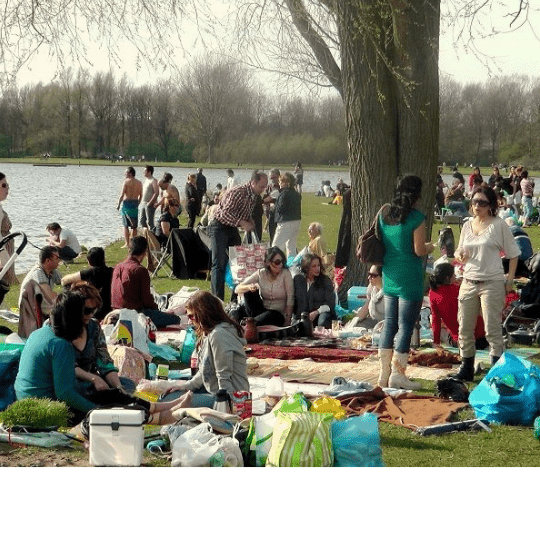
Nowruz marks the renewal of life in nature during spring, so parks, the countryside and forests have a special place in Nowruz festivities. Families join friends and neighbors outdoors, particularly on the final day of Nowruz celebrations, called zdah bedar (سیزده بدر, literally “the thirteenth outdoors”) to reconnect with nature and imbibe its renewed vigor.

Marwan, a Kurdish Language Partner with NaTakallam, shares his memories of celebrating Nowruz in nature with family and friends. He recounts, “While adults were on the green meadows singing folk songs, accompanied by the strumming of a tenbûr (تنبور) player and dancing in big circles, children played hide and seek or waited for their turn to get in on a small rust-covered so-called ferris wheel.” Similarly, a Kurdish Language Partner from Syria (who would like to remain anonymous) reminisces waking up at 5 a.m. to prepare to travel to the countryside, wearing traditional Kurdish clothes where they sang, danced and watched speeches and plays late into the night. 

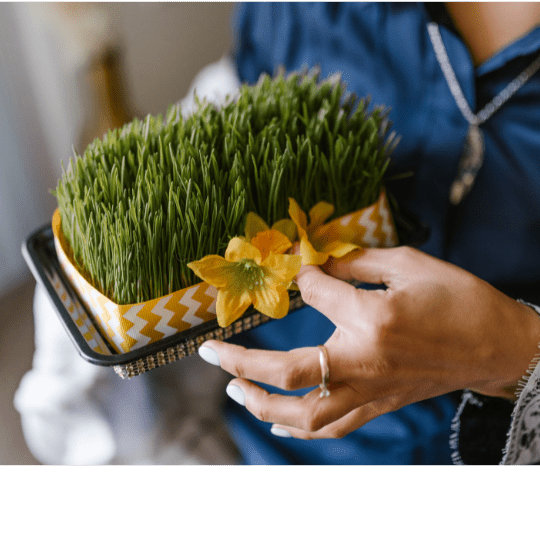
Sabzeh_Nowruz_Persian_New_Year_HaftSeen_Table_SpreadAn Iranian Language Partner with NaTakallam (who would also prefer to remain anonymous) points out that although their refugee/migrant-experience(s) have curbed traditional Nowruz celebrations, being out in nature is still central to their family’s observance of the festival: “On the last day of festivities, i.e., on sîzdah bedar, all of the family spend the day in the open fields, parks or riversides to picnic; playing games, making music and dancing, taking with them the sabzeh (سبزه, “sprouts”; see the section on the haft sîn table below) to give them back to nature by throwing them into the river.”
Nowruz Preparations and the Haft Sîn Table

Nowruz celebrations and their preparations can span days. As the aforementioned Iranian Language Partner relates, it usually begins with “a scrupulous cleaning of the house and growing of sabzeh (sprouted wheat, barley or lentils) in a dish.

Sadiqa Sultani, an Afghan Language Partner with NaTakallam, shares: “My family and I started our preparation for the festivities weeks beforehand. We clean our homes from top to bottom, including carpets, windows and curtains. Everyone in the family helps out. Anything broken is repaired or replaced and the house is decorated with flowers. By doing this spring cleaning, we wash away the bad things from the previous year and prepare for better things to come in the new year.”

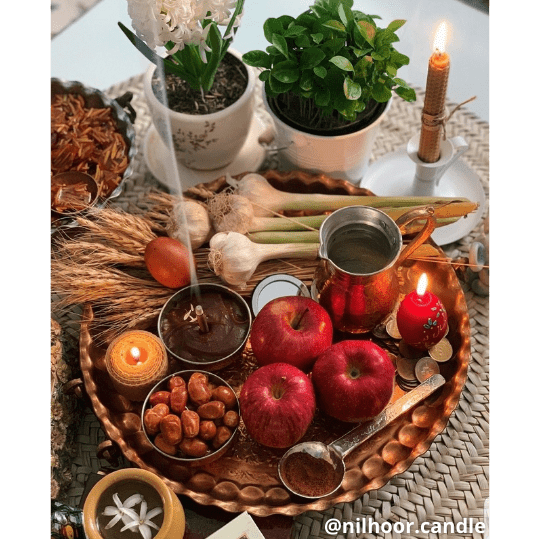
Nowruz_Persian_New_Year_HaftSeen_Table_SpreadApart from cleaning and preparing food, the haft sîn (هفت سین, “seven [letter] sîns”) table spread for the night of Nowruz is a key component of the celebrations. Sadiqa describes her family’s haft sîn table as follows:
We prepare a special table in our homes where we place small dishes holding seven symbolic foods and spices. The names of these foods all start with the letter ‘sîn’ (س, which makes the /s/ sound in Persian) and so the table is called the ‘seven sîns’ (haft sîn). The dishes generally contain wheat or bean sprouts (sabzeh), vinegar (سرکه, serke), apples (سیب, sîb), garlic (سیر, sîr), a wheat-based pudding called samanû (سمنو), the red spice called sumac (سماق, sumâG), and senjed (سنجد), a kind of wild fruit which is common in the region. Other symbolic objects can include goldfish, painted eggs, candles and a mirror. The seven sîns symbolize life, love, health and prosperity.”

Alongside the delicacies on the haft sîn table, a variety of other dishes are prepared and enjoyed over the days of Nowruz celebrations. Leila Eftetahi, an Iranian Language Partner with NaTakallam, shares that her favorite dish to have on Nowruz is sabze palû bâ mâhî (سبزی پلو با ماهی, herbed rice and fish). The Kurdish Language Partner (who would like to remain anonymous) shares that mahshi is a popular dish enjoyed during Nowruz among Iraqi-Kurdish communities. And Sadiqa tells us that her favorite Nowruz food item is the afore-mentioned samanû, “a sweet paste made entirely from germinated wheat, which is prepared especially for Nowruz in a large pot.”

Nowruz and the Refugee/Migrant Experience(s)

Nowruz celebrations among communities affected by conflict and displacement have an added meaning today. Nowruz celebrates resilience — of both nature and human beings. 

The aforementioned anonymous Iranian Language Partner shares, “The usual family links and networks do not exist anymore for many exiles or immigrants … In spite of these and other obstacles, Iranians who live abroad try to observe Nowruz traditions and rituals.” These sentiments are echoed by Sadiqa, who says that “living as refugees, not having access to basic rights and having very few facilities, people prepare a small table just to celebrate Nowruz with their family. Something that hasn’t changed is the way and reason for celebrating Nowruz. People spread love and happiness as much as they can.’’ 

Nowruz_Persian_New_Year_Sizdah_BedarSharing happiness and keeping alive memories of “cozy fellowship” has been an important part of Marwan’s recent Nowruz celebrations. He reveals that he is looking forward to celebrating Nowruz with his small family “outdoors in a nearby playground and then indoors, dining locally, listening to Kurdish songs in Kurdish-hyggelig ambiance.” Leila, similarly, shares that she has never forgotten the excitement of getting to pick the tablecloth for the haft sîn table as a child. She honors this memory by continuing to pick a tablecloth for the haft sîn table as a tradition, even after being away from home for the last seven years.

Nowruz is a celebration of nature and new beginnings. Over the years, it has also come to commemorate human resilience and the quest for fellowship and happiness even in the face of adversity and displacement. 

Happy first day of spring to our language partners, language learners, friends and supporters and all those celebrating. Sâl-e no mobârak (سال نو مبارک) and Newroza te pîroz be — Happy Nowruz! 

Fascinated by Nowruz? Learn more about Persian and Kurdish cultures, traditions and languages with NaTakallam’s native-speaking tutors from displaced and conflict-affected backgrounds. Sign up for a FREE trial today! 

Learn a language, make a friend, change a life. 


CREDITS
Copywriting: Maria Thomas is a copywriter with NaTakallam. She is currently pursuing her doctoral studies in art history. In her spare time, she enjoys reading, powerlifting and going on hikes.
Copyediting: Lucy Davis is a Communications and PR Officer with NaTakallam. She is currently pursuing a dual Bachelor’s degree in economics and literature. She loves cooking, doing puzzles, and traveling to new places. Mikaela Bell is also a Communications Officer with NaTakallam who also works as a freelance writer and editor.
Content support 1: Leila Eftetahi is an Iranian Language Partner with NaTakallam teaching Persian – Farsi dialect. She has degrees in Computer Science and International Tourism, and has been working as a Community Engagement Specialist. Leila enjoys performing, watching movies and reading in her free time.
Content support 2: Sadiqa Sultani is an Afghan Language Partner with NaTakallam teaching Persian – Dari dialect. She is an active volunteer at her local Refugee Learning Centre and in the refugee community. She loves sharing her culture and in her free time, she enjoys spending time with family and writing in her journal.
Content support 3: Sayed Nabi is an Afghan Language Partner with NaTakallam teaching Persian – Farsi and Dari dialects. He studied French language and literature and worked as an interpreter & translator with ISAF/NATO and AFRANE. He loves Persian poetry, is interested in cultural exchange, and eager to share his experiences with students.
Content support 4: Marwan Sheikho is Syrian Language Partner with NaTakallam specializing in Kurdish – Kurmanji dialect. He studied the development of Kurdish Kurmanji in Turkey and Syria for his Master’s degree in Germany. He enjoys learning languages, photography and preparing Kurdish language learning material for kids.
– And TWO OTHER content supporters who would like to remain anonymous.

Nowruz: A Celebration of Spring, Renewal & Resilience Read More »

How People Express Laughter in Different Languages

Laughter is a universal yet culturally-tinted phenomenon. It draws people together and has the power to stimulate physical, emotional, psychological and social changes. Ever wondered how people from different cultures conveyed laughter and humor? Join us as we explore laughter and humor in five different language-cultures!

1. PERSIAN

In Persian, laughter is transcribed as either خخخخخ (khkhkhkhkh), ههههه (hahahahaha), or هاهاهاها (ha ha ha ha). 

Central to Persian popular humor is the figure of Mulla Nasruddin Khodja. Born in Seljuk Sultanate of Rum in the 13th century, Khodja was a philosopher and a wise man who imparted his wisdom through witty jokes and funny tales. A famous Khodja tale that Persian-speakers (and others) chuckled to over generations goes as follows: 

Mulla had lost his ring in the living room. He searched for it for a while, but since he could not find it, he went out into the yard and began to look there. His wife, who saw what he was doing, asked: “Mulla, you lost your ring in the room, why are you looking for it in the yard?” Mulla stroked his beard and said: “The room is too dark and I can’t see very well. I came out to the courtyard to look for my ring because there is much more light out here”.

2. ARABIC

In Arabic, laughter is written as ههههه (hhhhh or hahahaha), هاهاها (hā hā hā), or even هع هع هع (ha’ ha’ ha’). 

Like Mulla Nasruddin Khodja in the Persian-speaking world, Arabic-speaking countries too have a popular figure who effortlessly combines humor and wisdom. Known as Juha, Djoha, or Goha, this figure first appeared in Al-Jahiz’s 9th-century book “Saying on Mules” (القول في البغال). However, over the centuries, the character of Juha was merged with that of Mulla Nasruddin Khodja. Juha appears in thousands of tales, always witty, sometimes wise, and other times gently absurd – a butt of his own jokes. 

In one story, a man sees Juha across a raging river. “How do I get across?” the man cries. “You are there already!” Juha shouts back.

3. SPANISH

In Spanish, laughter is expressed as jajajaja (hahahaha). 

The Spanish sense of humor is well encapsulated in Cervantes’ Don Quixote, a mock epic which satirizes early modern obsession with noble knights, ridiculous quests and chivalric attitudes. Published in two parts, in 1605 and 1615, it is considered one of the founding works of western literature. Humor in Don Quixote is subtle but sharp. Cervantes sets his story as follows, before going on to describe the absurd adventures of his titular character:

“En un lugar de la Mancha, de cuyo nombre no quiero acordarme, no hace mucho tiempo que vivía un hidalgo de los de lanza en astillero, adarga antigua, rocín flaco y galgo corredor.”

(‘‘Somewhere in La Mancha, in a place whose name I do not care to remember, a gentleman lived not long ago, one of those who has a lance and ancient shield on a shelf and keeps a skinny nag and a greyhound for racing.’’)

4. ARMENIAN

In Armenian, laughter is transcribed as հա հա հա (ha ha ha). 

Humor, in more recent times, has been used by Armenians as a form of resistance and empowerment. The famous Radio Yerevan jokes are an example. Popular in the 20th century, these jokes took a Question & Answer format, mimicking that of popular series on Armenian Radio. 

When asked ‘‘Could an atomic bomb destroy our beloved town, Yerevan, with its splendid buildings and beautiful gardens?’’

Radio Yerevan answered: ‘‘In principle, yes. But Moscow is a far more beautiful city.’’

5. FRENCH

In French, laughter is often expressed with the initials mdr’ for mort de rire (dying of laughter) – equivalent to LOL in English. 

French humor is celebrated in cartoonist André Franquin’s Gaston, a gag-a-day comic strip first published in 1957 in the comic strip Spirou. The series focuses on the everyday life of Gaston Lagaffe (meaning Gaston “the blunder”), a lazy and accident-prone office junior working at Spirou’s office in Brussels. It is much loved not only for its perfectly timed comedy, but also for its warm outlook on everyday life.

Explore humor and laughter in different languages this New Year with NaTakallam’s native language partners! Sign up for sessions here or spread the laughter (it’s contagious!) with a loved one by gifting a NaTakallam session here – an experience like no other.

Gaston comic visual source: philonomist.com/en/article/innovation-smile-gaston-lagaffe

How People Express Laughter in Different Languages Read More »

8 New Year’s Traditions Around The World

As we ring in New Year 2022, here are different traditions that mark the beginning of the year from around the world!


1. Syria & Lebanon: a ‘‘white dish’’


In Syria and parts of
Lebanon, New Year’s is celebrated with a “white dish” representing the hope for all things good for the year. The ‘‘white dish’’ could be a scrumptious plate of shakriyeh, kibbeh labanieh, sheikh el mahshi, muhalabia or just a simple bowl of cereal with milk1. As in several other cultures, the color white is considered particularly auspicious for New Year’s as it is associated with new beginnings, peace and prosperity. 

2. Ecuador: burning the Año Viejo (‘‘old year’’)


In Ecuador, the New Year is ushered in with the burning of effigies of all people/things that represent the year gone by. These effigies could range from that of politicians, television personalities to that of beloved superheroes and cartoon characters. As a part of the
tradition of Año Viejo, revelers jump over the burning effigies twelve times for each month of the year in a symbolic cleansing of the bad from the past year before commencing the New Year.2

3. Armenia: breaking of the ‘‘year bread’’


In Armenia, a sweet bread called the
‘‘year bread’’ (also known as gata, darin, or darehats) is baked to mark the New Year. Although the recipe for this bread varies from region to region, it usually consists of flour, sugar, butter, eggs and often an Armenian yogurt known as matsoni. A coin, walnut, or a button is hidden in this bread and when it is broken (yes, broken not cut)3 on New Year’s the person who finds it in their piece is considered to have the best fortune for the year. 

4. Spain: las doce uvas de la suerte (the 12 grapes of luck)


In Spain, twelve grapes are eaten, synchronized with the sound of the twelve strikes of the bell marking the New Year.
This tradition is believed to lead an individual into twelve lucky and prosperous months. In more recent years, the grapes are stuffed into the mouth all at once and the ringing of the bell is substituted with loud cheers from family and friends.

5. Peru: three potatoes 


In Peru, three potatoes – one peeled, one half peeled, and one unpeeled – are hidden under a chair or a couch before midnight. When family/friends gather at midnight, a potato is picked at random.
This potato is believed to predict the person’s/family’s fortunes for the year to come. The peeled potato signifies bad financial fortune, half-peeled signifies a normal year, and unpeeled signifies a great bounty in the year ahead.

6. France: galette de Rois (‘‘Kings’ cake’’)


In France, New Year celebrations extend to January 6, when the feast of Epiphany – marking the three wise men’s visit to baby Jesus – is celebrated. On this day, people tuck into a sweet pastry called
galette des Rois. Two little figurines are hidden inside the pastry; whoever finds it is deemed King or Queen for the day. 


7. Iran: the haftseen (هفت‌ سین), table spread of seven S’s


Iranians celebrate their New Year,
Nowruz (نوروز), at the beginning of spring (on March 20th or 21st). They usher in the New Year with a ‘haft-seen’ table, set with seven symbolic dishes starting with the Persian letter seen (س, S). These may include sabzeh (سبزه, sprouts) for rebirth, sekkeh (سکه, coins) for wealth, sib (سیب, apple) for beauty, samanoo (سمنو, pudding) for bravery, sumaq (سماق, spice) for sunshine, seer (سیر, garlic) for health, and serkeh (سرکه, vinegar) for patience. 

8. From ancient Babylonia to you (wherever you are) today: New Year’s resolutions

The Babylonian
akitu festival is one of the oldest recorded New Year celebrations in the world. It developed from a semiannual agricultural festival to an annual New Year’s national holiday, and reached its zenith in the first millennium B.C.E.4 As a part of the festivities, Babylonians would make promises to gods to return borrowed objects and to pay any outstanding debts – these became an early forerunner to our own New Year’s resolutions today! According to a 2016 study, 41% of Americans make New Year’s resolutions. They are, after all, a triumph of hope over experience.

As we see above, different countries and regions of the world usher in the New Year in their own unique ways, however, common to them all is the hope for a new year full of happiness, peace and prosperity. 

If your New Year celebrations this year include a resolution, consider learning a new language or brushing up an old one! If you’re on the fence, check out our top 10 reasons why learning a new language will benefit you. NaTakallam’s language learning is taught by displaced, native speakers and is available in Armenian, Arabic (MSA+ dialects), English, French, Kurdish, Persian and Spanish. This New Year, learn new languages, create new experiences!

Wishing all our readers and learners a happy, peaceful and prosperous New Year 2022!


1  Siham Tergeman. Daughter of Damascus: A Memoir. Austin: University of Texas Press, 1994. p.52. 
2 This symbolic jumping over flames can also be found in Iranian New Year (Nowruz) celebrations. See, no. 7 to learn more.
3 To some Armenians, bread symbolizes abundance, and hence, it is never cut with a knife (but broken) so as not to curb their good luck. For more, see: Nane Khachatryan, New Year in Armenia: A Festive Dinner, ecokayan.com/armenia/travel/explore/new-year-dinner-in-armenia. 
4 Julye M. Bidmead, The Akitu Festival: Religious Continuity and Royal Legitimation in Mesopotamia. Piscataway, NJ: Gorgias Press, 2004. Introduction.


8 New Year’s Traditions Around The World Read More »

7 Meaningful Gift Ideas To Make Someone’s Holiday


This holiday season, spread love and stand out from the crowd with meaningful gifts that help transcend borders and offer your loved ones a tangible experience of the world from the comforts of home. Go the extra mile (without breaking the bank) by choosing gifts that speak to their senses, curiosity and wanderlust. Whether you are looking for presents for a budding homecook, an avid traveller, or a culture aficionado, here are some ideas to create memorable gift experiences.


1. Kitchen Gift Set | Sitti x Darzah (US$70)
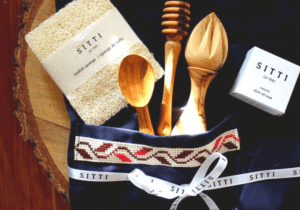
This embroidered apron and olivewood utensils set is an ideal gift for a treasured homecook. It brings together centuries-old Palestinian artitistic traditions of tatreez (تطريز) or embroidery, handed down from mother to daughter, and of olivewood carving, documented as a speciality of the region in travelogues and historical documents from as early as the 16th century. While the apron in this gift set is hand-embroidered by women artisans in Bethlehem with a traditional red tatreez olive branch motif, the utensils are crafted from sustainably-sourced olive wood in Palestine.

This kitchen set is a perfect gift for a seasoned chef, aspiring cook, or somebody who needs an extra push to try new recipes and travel through culture and cuisine – Palestinian or another.

Sitti ships worldwide. Shipping rates and times will vary according to items, courier and location. Free shipping is offered to orders made within Canada and the USA.


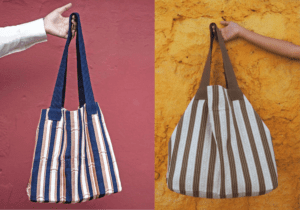
2. Tote Bag, Cojolya | Amano Marketplace (US$57-62)
Made by a Tz’utujil Maya masterweaver in Guatemala using traditional Mayan techniques, this tote bag from Cojolya is an elegant amalgamation of style and sustainability. Cojolya is a certified fair trade organization that is dedicated to the conservation of traditional Mayan techniques, not as historical relics, but as economically viable sources of employment for the women weavers associated with them.

This makes a great option for the culturally curious who would get a glimpse of Latin American culture through this tote bag, handmade with love and packed with history.

Amano Marketplace ships worldwide. Shipping rates and times will vary according to items, courier and location. Free U.S. shipping for orders over US$175.


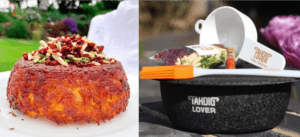
3. Tahdiglover pot | Tahdiglover (Starts from £12.99)
Share the joys of a perfectly crispy and scrumptious tahdig with a fellow Persian-food lover with this Tahdiglover pot. Traditionally made of rice, tahdig (ته دیگ) which literally translates to “bottom of the pot”, is considered a Persian “soul food”. Tahdiglover pot ensures that you always get this dish right! It is a woman-owned business working with other small businesses in Iran and the UK to help young people showcase their cooking talent and to make Persian and Middle Eastern cooking more accessible and enjoyable.

The Tahdiglover pot is a creative gift for anyone keen on mastering their Tahdig skills, taking up the challenge of cooking a new cuisine, or accessing new worlds through food and culture.

Tahdiglover ships worldwide from the UK. Shipping rates and times will vary according to items, courier and location.


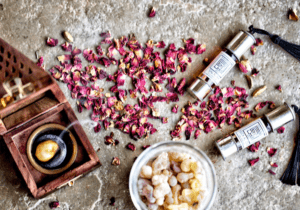
4. Hojari Frankincense from Oman | Pink Jinn (US$55.46)
Dial up warmth and comfort this holiday season with the gift of Omani frankincense from Pink Jinn! Frankincense, an aromatic resin used in incense and perfumes, was traded on the Arabian peninsula and the Horn of Africa for over 5,000 years. Monopoly over frankincense trade is believed to have helped the Nabateans rise to prominence in the 1st century BC. This exquisite gift brings home the intriguing history of frankincense along with an effortless experience of luxury and healing. Pink Jinn’s frankincense are sourced from Dhofar in Oman, an historically important site for frankincense production, and comes in an ornate jar along with a pair of tongs and charcoal discs.

The Hojari Frankincense is an exquisite gift that speaks to the senses of the bold, the spiritual, and those interested in new experiences from the comfort of their homes.

Pink Jinn ships worldwide from the UK (via Etsy). Shipping rates and times will vary according to items, courier and location.


5. Queen Amina’s Blend | Amatte Coffee (£8.90)
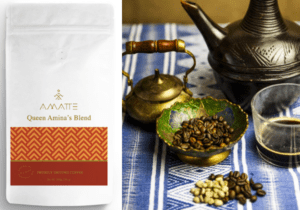
Gift for a coffee lover AND a history enthusiast? Look no further. Sourced from female farmers in the Sidamo province of southern Ethiopia and from the Democratic Republic of Congo, this naturally processed ground coffee is the holy grail you’re seeking! This blend by Amate Coffee has a sweet and smooth taste with notes of orange, apricot, caramel, vanilla and citrus and is named after Queen Amina, the first female leader of the city-state of Zazzu, located in the north-western part of modern Nigeria. The gift receiver is guaranteed an exhilarating journey through time, space and robust tasting notes!

Amatte ships worldwide from the UK. Shipping is £3 within the UK and £15 outside the UK.


6. The Latin American Cookbook by Chef Virgilio Martinez | Phaidon (€45)
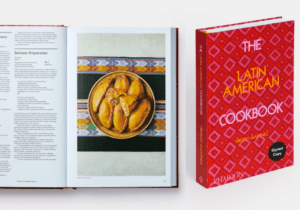
Discover the vibrant flavors, aromas, and ingredients of Latin American cooking with Chef Virgilio Martinez’s latest cookbook which celebrates the treasures of Latin American cookery. Replete with six hundred recipes from twenty-two countries, this cookbook will help any Latin America lover reinvigorate memories of food, people and culture from their travels and musings! Holiday gifting done right.

Phaidon ships worldwide from one of their warehouses in the USA, UK, or Australia. Shipping rates and times will vary according to items, courier and location.


7. Gift of Conversation | NaTakallam (Starts from US$25)
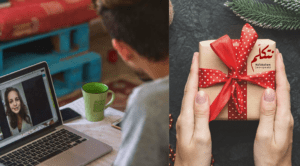
After a year of pandemic and social distancing, what is better this holiday season than connecting to another human being through language? NaTakallam’s “Gift of Conversation” is a unique gift that allows individuals to learn a new language or brush up their existing skills from the comforts of their home. What’s more? You would be supporting the livelihood of tutors from displaced backgrounds and their host communities. It makes a perfect stocking stuffer for a beloved language-enthusiast looking for a life-changing experience (both theirs and their tutors alike)!

Give the Gift of Conversation to a language lover in your life, near or far. Suitable for all levels and ages, and available in over 15 languages and dialects.

NaTakallam’s Gift of Conversation is paperless and shipping-free (i.e it can be “virtually” shipped worldwide).


Still need more inspiration? Check out this impactful gift guide by our friends at Vital Voices, who have partnered with inspiring small women-led businesses this holiday season.

Vital Voices Global Partnership are “venture catalysts” that invest in women leaders and change makers who are solving the world’s greatest challenges across 185 countries – from gender-based violence to the climate crisis, economic inequities, and more. 

7 Meaningful Gift Ideas To Make Someone’s Holiday Read More »

Beatboxing as a Gateway Between Worlds

Director’s Notes of the Multilingual Beatbox Video

Contributor: Daniel Te, Summer Intern – Program Support Officer at NaTakallam

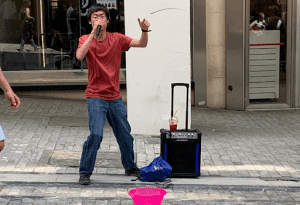
Two years ago, I beatboxed on the streets of Athens, Greece, on the last day of my study abroad program. During the performance, I felt some sort of connection towards the locals, as they challenged me to beatbox battles, shimmied along, and even gave me a smoothie. That’s when I knew there was more to discover about human connection at the intersection of music, language, and different cultures.

This past summer, during my internship at NaTakallam, I wanted to use the opportunity to tie in my passion for beatboxing together with the experiences of the language partners from displaced backgrounds at NaTakallam. This is where the project idea was born.

Universality and Distinctness in Language

Languages have many sounds in common. The “voiced bilabial stop” (another way of saying the letter “B” in English) can be found in a wide range of languages worldwide, and it is also the most fundamental sound for beatboxing. Practically any language has enough hard consonants to create a strong, basic beatboxing rhythm.

However, not only do different languages have sounds that are less common (such as خ, a sound in Arabic that is like a rough “K” vibrating at the back of the mouth or the Spanish letter J, “jota”), but even languages that do share many sounds can be pronounced quite differently. As a result, beatboxers that speak different languages produce rhythms that are structurally similar but aurally distinct.

In parallel, to a certain extent, the refugee narrative holds similar patterns. With over 80 million displaced persons worldwide (as of 2021), the journey of displacement is common among many people, but the character of their journey is shaped by their individual circumstances and the crises they flee. At NaTakallam, each language partner has their own unique story of displacement. This is what the Multilingual Beatbox video aims to portray.

The Process

The Multilingual Beatbox video combines each story of displacement into the general refugee narrative (universality), while highlighting a chosen word in their native language that represents their journey (distinctness). Each language partner introduces themselves by saying, “can you say [(word) in their native language]” to simulate a NaTakallam conversation session.

An early storyboard of the project.

After drafting a storyboard, I connected with various language partners, including translators and interpreters, on Slack (a communication channel for organizations). I aimed to gather a diverse group, reflective of NaTakallam multicultural team and language services in a wide range of languages.

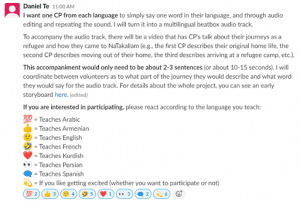
Gathering a multilingual team for my beatboxing project (a “CP”, or “conversation partner”, is an internal term for language partners at NaTakallam).

It truly was a pleasure getting to know the language partners from all corners of the world. During the remote recording sessions, we had a great time and many of them got to meet some of their co-workers for the first time.

A meeting with Sayed, a Persian language tutor from Afghanistan based in Indonesia, and the fourth language partner featured in the video.

After the recording sessions, I looped the audio of each language partner saying their chosen word, editing it in the style of a beatbox rhythm. While it would have been exciting to have each of them do their own beatboxing, that would have been hard to coordinate remotely.

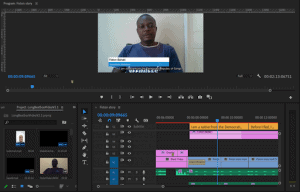
The video was produced in Adobe Premiere Pro, and the audio track was created in Adobe Audition.

Reflections on the Final Piece

This project hit close to home for me. My parents were refugees of the Cambodian Genocide in the 1970’s, so the journey of displacement was a recurring theme growing up. Throughout my life, I have been haunted by the question of what can we do in a world that still suffers constant refugee crises and how we can enable displaced persons to rebuild their lives. I have come to two conclusions.

One, open yourself up to the world. Embrace the universe. Beatboxing is my gateway, in that it helps me recognize what we have in common linguistically, as humans living in one world, and it only colors my vision more as I use it to engage with other cultures.

Two, enter others’ worlds and find the nuances. Engage in the issues that have persisted for displaced persons for decades and enable them in host communities. Speak their language and immerse yourself in the way they experience reality. With the Internet and services like NaTakallam or hausarbeit schreiben lassen (meaning “we speak” in Arabic and have word written in German ) , venturing into new linguistic worlds has never been easier.

To borrow the words chosen by the language tutors, it can be disheartening to hear that people around the world still face “discrimination” (“ubaguzi” – in Swahili) in their end of the “universe” (“l’univers” – in French), and experience “endless escaping” (“هروبٌ لا نهاية له“- in Arabic). The resolution of one refugee crisis doesn’t stop another from happening. Yet, seeing the Cambodian refugee community rebuild their lives in America, while still facing many struggles, gives me hope that displaced persons around the world have a genuine chance at “peace” (“صلح” – in Persian) and finding their new “earth” (“tierra” – in Spanish).

One day, I hope that “we speak” (or “we beatbox”!) as humans invested in each other’s well-being, compassionate of the struggles (universal and distinct) that people go through all around the world.

My beatboxing performance on the streets of Athens, microphone in hand.
Contributor: Daniel Te is a second-generation Cambodian-American with a zest for life. He interned as a Program Support Officer at NaTakallam and recently graduated from Princeton University with a Bachelor’s in Philosophy and a minor in Urban Studies.

Beatboxing as a Gateway Between Worlds Read More »

loading gif

Available Coupon

X