Cultural Insights

Courage In The Impossible: Gaza’s Poets Speak

Poets from every culture and continent were honored earlier this spring on World Poetry Day. Now as April unfolds, Americans enjoy National Poetry Month. It is a time to celebrate poets, but it is also a time to raise your voice. For the poets of Gaza, the need to be heard has never been greater. Over the past six months, tens of thousands of Palestinian civilians have been killed. For many, poetry has provided an escape. 18-year-old poet Nadine Murtaja took up the pen to mourn her homeland: “But here where I live, and breathe, life wears its black dress constantly.” Other young poets of Gaza also cling to the balm of the written word. 22-year-old Maha Jaraba shared: “The only thing that relieves us from the troubles of war is poetry.” 

Poetry as Solace in Gaza

Murtaja and Jaraba are both members of the Gaza Poets Society, a spoken word poetry group formed in 2018 by Mohammed Moussa. Moussa saw a need for poets in his homeland to gather because “life here is poetry blown into pieces and scattered all over the place.” Because poetry is not only a form of escape, it is a form of resistance. In fact, renowned Palestinian poet Mahmoud Darwish wrote that “every beautiful poem is an act of resistance.” Unfortunately, many poets have been targeted by occupation forces for speaking up and speaking out. 

On November 20th, Mosab Abu Toha was arrested when fleeing Northern Gaza and heading south toward the Rafah crossing. Mosab Abu Toha is the founder of Gaza’s Edward Said library and the award-winning author of Things You May Find Hidden in My Ear: Poems from Gaza. While Toha was eventually released, the harrowing experience stirred feelings that could only be expressed through poetry. As Toha wrote: “A poem is not just words placed on a line. It’s a cloth. Mahmoud Darwish wanted to build his home, his exile, from all the words in the world. I weave my poems with my veins. I want to build a poem like a solid home, but hopefully not with my bones.” When Toha finally reached Egypt, he arrived with only one book in hand: a weathered copy of his poetry collection.

“I Grant You Refuge” by Palestinian poet, novelist, and teacher, Hiba Abu Nada, was written on October 10th and is among the last pieces she composed before being martyred by an Israeli airstrike on October 20th. Read the full text with translation by Huda Fakhreddine here.

Palestinians Speak, The World Listens

To the poets of Gaza: The world is listening. As of December 2023, #palestinianpoetry had more than 206,500 views on TikTok and #mahmouddarwishpoetry had 17.8 million views. At the Boston Coalition for Palestine on December 17th, demonstrators calling for a permanent ceasefire decorated white kites adorned with lines by Refaat Alareer, a Palestinian poet killed by an Israeli airstrike. His lasting plea? “If I must die/ you must live/ to tell my story”. And indeed, the story lives on. From online poetry forums to in-person events and readings, thousands of dollars have been raised by the power of the written word. In London, Out-Spoken Press organized a virtual event called “Poets for Palestine,” which ended up raising nearly £25,000 for Medical Aid for Palestinians. 

In Arabic, the word for poetry is شعر (shi3r), which also means “to feel.” As the violence in Gaza continues and hearts are rubbed raw, it is no surprise that the Gaza Poets Society continues to pour forth. With nearly 27,000 followers on Instagram, the message is clear: This broken world needs poetry.

Want to experience the beauty of Arabic poetry or discover new Palestinian voices? Book a session with one of NaTakallam’s native language tutors! Choose from Modern Standard Arabic and local dialects: Levantine (spoken in and taught by language partners from Jordan, Lebanon, Palestine, and Syria), Lebanese, Palestinian, Egyptian, Iraqi and Yemeni. 

ABOUT THE AUTHOR: Emily Reid Green is a content writing intern with NaTakallam. She has spent nearly two decades in education as an English teacher. In her spare time, Emily enjoys reading, singing and studying languages. 

Courage In The Impossible: Gaza’s Poets Speak Read More »

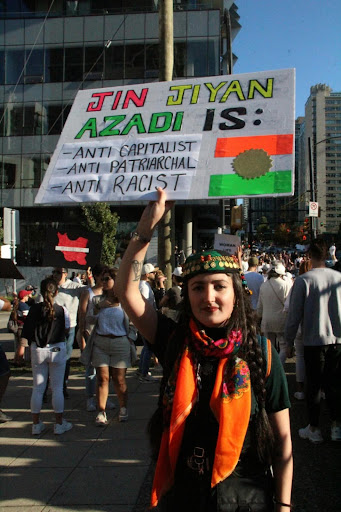
woman displaying a sign reading "jin, jiyan, azadi" or "woman life freedom" in Kurdish

The Kurdish Roots of “Woman, Life, Freedom”

Since the start of the ongoing Mahsa Amini Protests, which began in Iran in September 2022 after the murder of Jina Mahsa Amini at the hands of the Morality Police for not wearing her veil properly in public, we’ve heard the slogan “Woman, Life, Freedom” travel around the world. In Persian this is “zan, zendegî, âzâdî” (زن, زندگی, آزادی), but the slogan originates in the Kurdish language and the Kurdish struggle for autonomy.

The fight for women’s rights has long been intertwined with the Kurdish independence movement. The Kurdistan Free Women’s Union was established in 1995, and in the same year the Kurdish Workers’ Party (PKK), which had been co-founded in 1978 by a woman, Sakine Cansız, decided to promote the establishment of more independent female political, cultural, and economic organizations. These establishments were part of broader trends in Kurdish society and the liberalization of  Kurdish views on women’s roles. Abdullah Öcalan, also a co-founder of the PKK, theorized that the subjugation of women is the root of all other types of oppression and that society cannot exist in freedom unless women are free.

woman displaying a sign reading "jin, jiyan, azadi" or "woman life freedom" in Kurdish

In 1998, on International Women’s Day, the “Ideology of Women’s Liberation” was presented (possibly by Öcalan, though this is disputed) as a list of principles for women to follow in their emancipation battle. It stated that women had to break free not only from old social roles and the attitude that supported them, but also from total autonomy and self-organization. The Kurmanji Kurdish slogan “jîn, jîyan, azadî” started to become popular just a few years later. Its exact origins remain obscure, but it appeared after the arrest of Öcalan and the Kurdish independence leaders’ decisions to prioritize women’s rights as part of their movement.

​​In 2012, after the outbreak of the Syrian Civil War, Syrian Kurds established an autonomous government that platformed, among other planks, women’s liberation. The Syrian Women’s Protection Units engaged in combat against ISIS, while women’s civilian organizations continued to address patriarchal attitudes. As more territory was liberated from ISIS control, women from various non-Kurdish communities joined in the movement. They not only participated in the Autonomous Administration’s women’s institutions but also established their own organizations to cater to their specific needs. This bringing together of women across ethnic and religious lines showcased the universalist potential of the Kurdish women’s movement.

It is the history of this Kurdish women’s resistance tradition that has led Iranian Kurdish women to play a leading role in the ongoing Iranian protest movement, which was sparked by the murder of Jina Mahsa Amini, herself a Kurdish woman, but fueled by the desire to demonstrate against the Iranian regime. The slogan “jîn, jîyan, azadî” soon became the rallying cry of these protests, a reference to Amini’s Kurdish origins, and Persian speakers quickly picked it up, translating it to “zan, zendegî, âzâdî.” Although other slogans started circulating, “zan, zendegî, âzâdî” became the most popular one, thanks to social media and the efforts of the Iranian youth in spreading it outside Iranian and Kurdish borders. A notable example is the song “Barâye…” (برای”, “for”) by Shervin Hajipour, composed of various tweets explaining why people were protesting, or the anthem “Sorôde Zan” (“سرود زن”, “Women’s Hymn”) written by Mehdi Yarrahi. Both of these songwriters have since been arrested and sentenced to prison.

This slogan has now been translated into many languages, as people worldwide have shown solidarity for the cause and begun protesting against the current Iranian government. According to the scholar Handan Çağlayan, “the slogan is attractive for its spelling and rhythm and significant for its connotations.” Jîn and jîyan are two closely related words, but jîn in this case should not signify a glorification of womanhood; rather it means “claiming and supporting womanhood as a valuable identity independent of manhood.” Jîyan symbolizes the right to life, and azadî, the right to freedom, “symbolizing the mutuality between womanhood and Kurdishness in women’s political participation.”


Catalan government leaders hold a minute of silence for Mahsa Amini and all victims of gender-based violence outside the Barcelona City Hall beneath a sign that reads "woman, life, freedom" in Catalan and Persian.
Catalan government leaders hold a minute of silence for Mahsa Amini and all victims of gender-based violence outside the Barcelona City Hall beneath a sign that reads “woman, life, freedom” in Catalan and Persian.

The Kurdish Roots of “Woman, Life, Freedom” Read More »

romantic couple with guitar

Love Songs from Across the World

romantic couple with guitar
Photo by Andres Ayrton
Arabic

Fairuz, the most celebrated singer in Lebanese history and arguably one of the most iconic singers in the entire Arab world, offers such a plethora of haunting love songs that it’s hard to pick one, but we’d like to recommend one of the happier ones: “قمرة يا قمرة” (‘amara ya ‘amara), “Moon O Moon.” The lyrics and translation are in the video, or you can read them here.

Armenian

Յարը մարդուն յարա կուտա” (yareh mardu yara kuta), which means “The Lover Gives the Person Pain.” A classic Armenian love song that’s been remade a number of times. Click on the title for the version by Alla Levonyan, or try the version by Haig Yazdjian. Click here for the lyrics and a translation into English.

French

Congolese singer-songwriter Lokua Kanza is something of a polyglot, singing in six different languages. A beautiful and uplifting early example of his work is “C’est ma terre,” “It’s My Land.” Lyrics and translation are available here.

Kurdish

“Dil Kuştiyê” or “Broken Heart” was originally written by Mihemed Şêxo, and you can hear his classic version of it here. Like any classic hit, it’s been made and remade, such as this version by Diljen Ronî. See the text accompanying that second video for the lyrics, and let us know if you come across the English translation anywhere! (In the meantime, check with your Kurdish Language Partner for anything you don’t understand.)

Persian

Googoosh, a Persian diva who’s been singing since the 1970s, offers a live performance of “غریب آشنا” (gharibe ashena), meaning “Familiar Stranger.” You can view the lyrics here, and scroll to the very bottom for the English translation.

Russian

Kazakh rapper Jah Khalib sings in Russian and is one of the most popular singers across the former Soviet Union; he has made his home in Kyiv since 2019. “Лейла” or “Leila” is a relatively recent hit, and you can read the lyrics here.

Spanish

Everyone knows Colombian singer Shakira, but how many of her songs can you sing in their original language? “Whenever, Wherever,” the English version of her hit “Suerte,” is far from an exact translation. Check out the lyrics to see what changed.

Ukrainian

Rock band Okean Elzy formed in 1994 in Lviv and has been playing ever since. In their heartbreaking hit Obijmy, the singer turns to his lover for comfort in the midst of war. Lyrics and translation are here.

Got a favorite love song in a NaTakallam language? Comment and let us know? And if you prefer Spotify, we’ve collected most of these songs on a playlist there too. Pop on those headphones, prop up your feet, and put your cares behind you for a few minutes.

Love Songs from Across the World Read More »

deq, the art of Kurdish tattooing

Deq: The Art of Kurdish Tattooing

examples of deq, the art of Kurdish tattooing, with symbols inspired by nature

Tattoos and other forms of body art are a type of cultural expression shared by many communities across the world, but many of these unique cultural traditions are in danger of being lost to time and cultural hegemony. Across the Middle East and North African regions there is a rich tapestry of tattoo traditions, dating back thousands of years: Kurds, Turkmen, Arabs and nomadic tribes living in Eastern Anatolia wear them, as do Arab and Amazigh women living in Tunisia, Algeria and Morocco. “Deq” is the art of Kurdish tattooing.

One Woman Takes Up the Ancient Art

woman applies Kurdish deq
Elu works on a client.

Elu is a tattoo artist and a Zaza Alevi Kurdish diaspora woman from Dersim, in northern Kurdistan, eastern Turkey. She is one of the very few tattoo artists committed to keeping the art of traditional Kurdish tattooing, known as deq or xal, alive for another generation. Deq is the Kurdish word for “tattoo,” but the word has come to refer specifically to tattoos in the Kurdish style. I had the pleasure of interviewing Elu to learn more about this centuries-old tradition.

Elu entered the tattoo world by doing machine tattoos, but while traveling in Thailand she learned about Sak Yant, a sacred form of hand-poked tattooing done by Buddhists in southeast Asia. Inspired, she started hand-poking tattoos herself.  “As I was researching traditional skin markings around the world, I wondered if Kurdish people had any tattoo traditions, as I didn’t grow up seeing them in the diaspora (awaretî, derbiderî or sirgûn). Through an online search I came across deq and immediately found myself mirrored in it,” she says. “Later I found out my great-grandmother, whom I never got to meet but thank my path for, also had deq on her face.”

An Artistic Heritage of Women

There are many factors that make deq different from other forms of tattooing. First of all, the ink for deq is traditionally prepared with a mixture of soot and breast milk from a woman (jin) who has given birth to a girl (keç). It can also be made from a mixture of herbs and animal intestines. The tattoo itself is created by piercing the skin with a needle (derzî) that has been covered with the ink. Secondly, deq is traditionally done on women by women, on various areas of their body, such as the hands, breasts or even the face. Tattoos on men used to be rare, but this has changed: the younger generation is interested in keeping the deq tradition alive regardless of gender.

Kurdish tattooing
All photos in this article are examples of Elu’s work.

Tattooing is often done at a young age. Usually mothers or other women in the community tattoo their children (mindal or zarok), but sometimes kids try to tattoo themselves, mimicking the designs of their elders. As a result, traditional tattoo art endures across successive generations, evolving into a valued cultural heritage (kelepûr).

Kurdish tattooing

The symbols and patterns people choose to tattoo on their bodies are deeply inspired by nature and daily life. Common symbols include: the sun (roj), moon (heyv), and stars (stêrin); animals (ajel or lawir) like gazelle (xezal), birds and snakes (marin); plants (rewik); and daily life objects such as scissors (meqes or cawbirr), spindles and dolls (bûkoke). Lines and crosses are also common motifs and they can also be used to combine multiple drawings. And each symbol can have multiple meanings depending on the region, cultural background and individual desire.

People mark their bodies with deq for different reasons: some women believe their deq is a sign of beauty; others believe that deq has healing powers (tattooing dots on the side of the forehead can help against headaches, for instance); while others get tattoos for protection — for example, women may get them to ensure a safe pregnancy. They can also be an expression of nobility, pride, faith or belonging to a specific lineage — or simply of being in an exceptionally good physical state. Overall, deq is deeply rooted in spirituality, but it’s also a symbol of heritage and cultural pride.

Kurdish tattooing

From One Generation to the Next

When asked what deq means for Kurdish people, Elu says: “Nowadays, deq has become a cultural tool to build bridges between generations and over geographic distances. Some people mark the same deq as their mother (or dayik), grandmother (pîrik) or great-grandparents have, and others do it to create a bond with their culture and identity. While there are many personal reasons why Kurdish people practice deq, there is a collective desire to reclaim this almost-vanished tradition as a form of self-identification.”

deq on a Yazidi family

Elu mentions that the placement of the tattoo is also important. “The placement can also determine the meaning, which can be determined collectively or by the individual. A dot, for instance, can have a personal meaning for every individual.” She showed me an example of a Yazidi family without a gap between the generations practicing deq. All the children have received the same dot as their mother.

Unfortunately, deq remains an endangered tradition (kevneşopî). Over the years, fewer and fewer people have been practicing deq. It has even become frowned upon, and women may be averse to showing their tattoos or to talking about them. Religion (ol) could be one of the possible reasons: Islam, the dominant religion of the region, often forbids body modifications that are not done for medical reasons, and belief in any kind of spirituality apart from God is forbidden. Another reason could be the desire, or sometimes the necessity, for Kurds to assimilate into a mostly non-Kurdish society.

Elu, however, remains optimistic. When I asked her what could be done to prevent this art form from dying out, she replied: “The continuation is the biggest factor in saving this tradition from disappearing. I am sure we are currently experiencing and witnessing the renaissance of this tradition, especially through the Kurdish diaspora community (civaka derbiderî ya Kurd). Many more tattoo artists are beginning to mark deq again.”

Kurdish tattooing

However, she is also quick to add: “The tradition needs active practice as well as preservation in order not to be watered down into remains of what it once was. Therefore, a lot more research, documentation and archival work is needed. I truly hope to contribute to this with my work, as I truly believe in the power of ink, on skin as well as on paper.”

To look at and support Elu’s work, please visit her Instagram page.

Kurdish tattooing

Deq: The Art of Kurdish Tattooing Read More »

large Palestinian flag being shaken

The Origins and Meaning of Intifada

“Intifada” (إنتفاضة) is a term we often hear in slogans related to Palestinian resistance movements, the most famous and controversial being “globalize the intifada,” but what exactly is the meaning of intifada?

The word comes from the Arabic word “nafaDa” (نفض) which is a verb meaning “to shake the dust off something.” It could be used literally as “shaking [the dust] off the carpets” (نفض السجّاد) or figuratively, as “shaking off one’s laziness,” (نفض غُبار الكسل), or “being finished or rid of something” (سَئِم من المسألة، فقرّر نفض يدَيه منها; “He was fed up with the whole affair, so he decided to dust it from his hands.”) A similar sentiment is conveyed by the English expression, itself of ancient Hebrew origin, of “shaking the dust of something or someone from one’s feet.” As a related noun, “intifada” means “tremor, a shudder or a shiver.”

The First Palestinian Intifada: A Turning Point

It was in 1952 that the meaning of “intifada” took on its modern, political overtone of a “Middle East uprising,” when a series of protests shook the then-kingdom of Iraq in an attempt to force the king’s abdication in favor of a republic. It was then applied to Israeli-Palestinian conflict history when the first major Palestinian uprising against Israeli occupation started, in 1987. Up until that point, there had been no conscious, organized resistance movement against the occupation. The First Palestinian Intifada was the result of Palestinian recognition — led largely by women and students — that they would have to take their future into their own hands and could no longer wait for the international community to intervene on their behalf. Activists at that time chose the word “intifada” because it implied resistance that was aggressive but nonviolent. Palestinians were shaking off the dust of the occupation.

Media Influence on Intifada Perception

In her book A Quiet Revolution: The First Palestinian Intifada and Nonviolent Resistance, historian and activist Mary Elizabeth King largely blames the media for shifting the meaning of “intifada” in the Western mind and possibly even contributing to the escalating violence, detailing how international TV crews would avoid coverage of peaceful protests but focused in on rock-throwers and then the increasingly militant actions taken in response to heavy-handed Israeli reprisals. By the time the First Intifada ended in 1993, “intifada” was no longer associated with non-violence; the ground was thus laid for the Second Intifada, which arose from the failure of the Oslo Accords and lasted from 2000 to 2005, involving indisputable terrorist activities like suicide bombings and rocket attacks. Both uprisings were characterized by a heavy loss of life on the Israeli side and roughly three times as many losses on the Palestinian side.

The Second Palestinian Intifada had a profound impact on Palestinian-Israeli relations, contributing to a shift in Israeli attitudes and more relevance for Hamas, with increased skepticism toward the peace process and the two-state agreement.

Modern Misapplications of “Intifada”

On December 5, 2023, the presidents of Harvard, MIT, and the University of Pennsylvania were called into a hearing of the U.S. Congress to discuss allegations of growing antisemitism on their campuses as a result of the War on Gaza. During that hearing, Rep. Elise Stefanik of New York equated chants of “intifada” with a call for genocide against Jews. While the rise of Hamas and its terrorism cannot be denied, the term “intifada” significantly predates it. By no means is intifada a call to genocide or indiscriminate violence against Jews or, for that matter, Israelis.

The discussion and subsequent uproar over the presidents’ responses underline the importance of an accurate understanding of this controversial term. Given the gravity of the current situation in Palestine, it’s time to shake off our biases and ensure that our discourse is guided by integrity in our communications, informed by a sound knowledge of history.

woman waving Palestinian flag and making peace sign

Photo by Idriss Belhamadia

ABOUT THE AUTHOR: Mikaela Bell is a freelance editor and content writer with a background in anthropology and linguistics. An American based in France, she is also fond of reading, cooking, studying languages, fibercrafts and Irish stepdance.
ABOUT THE AUTHOR: Alice Zanini is a copywriting intern at NaTakallam. She is currently pursuing her bachelor’s degree in linguistics and Middle Eastern studies. Her research focus is on sociopolitical and sociolinguistic issues in modern Turkey and the Persian-speaking world.

The Origins and Meaning of Intifada Read More »

Christmas in Beirut, Lebanon

Christmas in the Arab World

Despite being the holiday of a minority religion in the Middle East, Christmas (ˁeid almiilaad, عيد الميلاد) is officially recognized in five Arab countries — Syria, Sudan, Jordan, Lebanon and Iraq — and is celebrated to some extent throughout the region. Join us for a deeper dive into special Christmas traditions in three Arab countries.

Iraq (عراق)

In 2018, Christmas was declared a public holiday in Iraq, and that holiday was made permanent in 2023. That said, the country has had Christian presence for centuries — in fact, it is estimated that the Christian community in Iraq is among the oldest in the Christian world. Christians believe that Abraham was born in the ancient city of Ur, which was located in what it is now southern Iraq. Today, most Iraqi Christians are Catholic, including the Chaldean Rite, the Syrian Rite, the Latin Rite and the Armenian Rite. The other Christians belong to the Nestorian Church of the East, the Syrian Orthodox Church and the Armenian Church. These churches are scattered all over the cities of Iraq.

Over the course of its history, the Christian presence has been more or less tolerated by the country’s (mostly Muslim) rulers, but most sources agree that since 2003, after the US’s invasion of Iraq and the consequent rise of extremist groups such as ISIS, Christians, alongside other religious minorities, have faced threats and persecutions. Sources estimate that the current Christian population in Iraq consists of between 300,000 to 200,000 thousand people: an estimated 5% of the Iraqi population. This is a huge decline compared to the 1.5 million Christians who were living in Iraq according to a government survey done in 1987. Many of them have emigrated to other countries. So how is it possible that Christmas celebrations are so popular in Iraqi cities?

The most common representation of Christmas in Iraq is the decorated Christmas tree, which can be seen in shopping malls, hotels and restaurants or in the main streets of big cities. The Christmas tree is more commonly known as the “New Year’s tree” there, and so it is not strictly associated with Christianity. Santa Claus (known in Arabic as بابا نوئل, Baba No’el) is also associated with the New Year (al-sina al-jadiid, السنة الجديدة) because he brings gifts like new clothes. Actual religious symbols such as the cross or Nativity representations are not seen as often in the streets, except in areas where a lot of Christians live.

Of course, Christmas remains very much a religious holiday for Iraq’s Christian communities. On Christmas Eve, Chaldean Christian families gather and hold candles while one of the children reads aloud the story of the birth of Jesus in Syriac, the language of liturgy for Assyrians and Chaldean Christians. After the reading, everyone sings over a bonfire of thorn bushes. Tradition says that if the thorns burn completely and turn to ash, the upcoming year will be a lucky and prosperous one. Afterwards, believers jump over the ashes three times and make a wish.

Iraqi Christians gather for a bonfire of thorn bushes.

Lebanon (لبنان)

With around 30% percent of the population being Christian, Christmas is big in Lebanon. The 18 different Christian communities present in the country also bring a lot of diversity to their Christmas celebrations. A lot of these communities celebrate Christmas on December 25, but the Armenian community celebrates on January 6 instead.

The festive atmosphere actually starts at the beginning of December. NaTakallam Language Partner Franceline Planche explains how, on December 4, Lebanese Christians celebrate Saint Barbara’s Day (ˁeid al-barbaara, عيد البربارة). Barbara fled from her father, a pagan king, but was eventually martyred. Because she disguised herself in order to flee, children will dress up in costumes and masks and go from house to house. This leads some to compare Saint Barbara’s Day to Halloween, but Franceline stresses that the holiday actually kicks off the Christmas season.

People also mark this day by planting wheat seeds in small containers. The seeds will sprout just in time for Christmas ready to be placed under the Christmas tree or beside nativity scenes. The wheat has a double meaning: it connects to the story of Saint Barbara, who escaped from her father, a pagan king, by running through a field of wheat which grew taller to cover her, and it also represents rebirth, directly referring to the birth of Christ.

Palestine (فلسطين)

Because of the war on Gaza, Palestinians have agreed to cancel any non-liturgical celebrations of Christmas for a second year running. In 2023 one Lutheran church in Bethlehem did set up a nativity scene — with a twist. The Christ child, wrapped in a keffiyeh, lies amidst the rubble of a destroyed building, representing the countless children who have been buried under the rubble of Gaza. At the same time, it reminds us that the original Christmas story took place in an occupied country — and thus maybe this scene can also be a reminder to hope.

ABOUT THE AUTHOR: Alice Zanini is a copywriting intern at NaTakallam. She is currently pursuing her bachelor’s degree in linguistics and Middle Eastern studies. Her research focus is on sociopolitical and sociolinguistic issues in modern Turkey and the Persian-speaking world.

ABOUT THE EDITOR: Mikaela Bell is a freelance editor and content writer with a background in anthropology and linguistics. An American based in France, she is also fond of reading, cooking, studying languages, fibercrafts and Irish stepdance.

Christmas in the Arab World Read More »

dancers performing Armenian folk dances

The Rich Tradition of Armenian Folk Dance

With around three thousand years of history, Armenia is steeped in culture and tradition, and Armenian folk dance (պար; bar) is a prime example of the country’s diversity. Each region has its own style and each of them has a special meaning, associated with rituals, traditions and faith. They are also a way to express emotions. Traditionally, many dances are performed in traditional Armenian dress (the տարազ or taraz) and involve props such as masks or knives.

Music is, of course, an important part of a dance. Armenian folk dance music is performed on folk instruments: the դուդուկ or ծիրանափող (duduk or tsiranapogh, a wind instrument made out of apricot wood, similar to a flute); the զուռնա (zurna, another wind instrument made out of wood, but closer to a clarinet); and the Դհոլ (dhol, a type of drum common not just in eastern Europe but also across Asia).

Armenian musicians

Originally gender mattered when dancing; women and men performed different dances. Nowadays, however, everyone can participate regardless of their gender. The dances serve as a vibrant expression of people’s entire lives, encapsulating their history, values and prayers, as well as moments of joy and sorrow. They are passed down through generations and remain an integral part of social gatherings like weddings and festivals. Even within the Armenian diaspora, there is a concerted effort to preserve and perpetuate these dance traditions, ensuring their continuation beyond the country’s borders.

Let’s have a closer look at the most famous Armenian folk dances:

Kochari

The Քոչարի or kochari is a lively, energetic dance that is believed to be one of the oldest traditional dances of Armenia.There are different versions depending on where you live, but it was inspired by the movement of rams fighting against each other. Initially the kochari symbolized a military victory and was performed by men, but nowadays it is performed during different celebrations by people of any age, gender and social status. The dancers hold each other’s hands in a line, shoulder to shoulder, and dance in a circle. The first person in the line holds a handkerchief and spins it. (The discerning reader may notice similarities to the Levantine دبكة, debka.) Kochari dancers often wear traditional costumes, which can vary depending on the region of Armenia they come from. In 2017, the kochari was added to the UNESCO Intangible Cultural Heritage List as a dance that “provides a sense of shared identity and solidarity, contributes to the continuity of historical, cultural and ethnic memory, and fosters mutual respect among community members of all ages.”

Want to give it a try? Check out this kochari tutorial!

Shalakho

The շալախո or shalakho is a dynamic, acrobatic dance known throughout the Caucasus region. There are different versions depending on the region, and the dancers also differ: in some areas it is only danced by women, only by men, or by women and men together. The most common variation is with two or more men “competing” to attract a woman’s attention. The male dancers use swords or sticks as props and perform fast-paced, energetic movements that involve jumping, kicking and spinning, while the women move in a more soft and delicate manner, with shorter steps. The shalakho is typically accompanied by the zurna.

Tamzara

The Թամզարա or tamzara is a traditional dance that originated in the Western region of Armenia, which is now part of Turkey. It is typically performed at weddings by men and women, who hold hands and move in a circular motion while crossing steps and swinging their arms. The music for the tamzara is usually provided by a dhol, and the dance is often accompanied by singing.

Yarkhushta  

The Յարխուշտա or yarkhushta is a war dance typically performed by men. The name probably comes from the union of the Farsi Persian words یار (yar), meaning “companion” or “lover,” and khusht, a small dagger. It involves quick, fast-paced movements, including high jumps and kicks performed to the sound of a dhol and zurna, and originally it was likely accompanied by war cries.The key element of the dance is a forward movement, in which participants rapidly approach one another and vigorously clap the palms of the dancers in the opposite row.

Like the tamzara, the yarkhusta originates in Sasun, in Western Armenia, now Turkey. However, many inhabitants of that area were displaced due to persecution and settled in the Talin region, in today’s Armenia, bringing their culture with them. In the 1930s, a famous ethnographer named Srbuhi Lisitsian, who taught in Yerevan, visited the villages of Talin to study their dances. He was the one who made the yarkhusta known to the whole country of Armenia. Most researchers say that the dance has medieval origins, while others argue that it dates back to Armenia’s pre-Christian period, but scholars agree that the dance has gone through almost no changes during the centuries.

We couldn’t decide between these two examples — why not comment and tell us which you prefer?

Berd

Finally, the բերդ, berd, or բերդապար, berdapar, whose name means “fortress,” is another famous Armenian military dance originally performed by men. Its name comes from a move performed during the dance, in which the dancers stand on top of each other’s shoulders to create a “fortress.” Originally from the old Armenian city Vaspurakan, near the Van Lake in Western Armenia, people say that before becoming a dance it was a game named Գմբեթախաղ or gmbetakhagh, which means “dome game.”

ABOUT THE AUTHOR: Alice Zanini is a copywriting intern at NaTakallam. She is currently pursuing her bachelor’s degree in linguistics and Middle Eastern studies. Her research focus is on sociopolitical and sociolinguistic issues in modern Turkey and the Persian-speaking world.

ABOUT THE EDITOR: Mikaela Bell is a freelance editor and content writer with a background in anthropology and linguistics. An American based in France, she is also fond of reading, cooking, studying languages, fibercrafts and Irish stepdance.
The Rich Tradition of Armenian Folk Dance Read More »

The Meaning of the Keffiyeh

With the ongoing war on Gaza, many people are eager to show their support for Palestine. One popular way to do so is by wearing the keffiyeh or kufiyyah (كوفية), a cotton or wool fishnet-patterned scarf. It can have different color variations but is usually a white background with black or red embroidered details. But what is the meaning of the keffiyeh? Its exact origins are unknown, but many Arab countries, such as Egypt, Jordan, Syria and Saudi Arabia, have their own preferred way to wear it. In the Palestinian context, however, it’s not just a fashion item — it’s an iconic symbol of Palestinian culture and identity.

woman wearing keffiyeh and carrying Palestinian flag

In the 1930s the keffiyeh was worn mostly by farmers and lower-class people from the villages, who used it as a headdress to protect themselves from the harsh weather conditions. This was seen as a symbol of social inferiority and backwardness by the upper class and townspeople, who wore a Tarbuush (طربوش; often called a “fez” in English from the Turkish fes): a rigid, red, conical hat. But during the Arab revolts against British forces, rebels started wearing the keffiyeh to conceal their identity and urged upper-class and townspeople to start wearing it too, so that the rebels could blend in when entering other cities. The British tried banning them, but this only encouraged Palestinians from all social backgrounds to start wearing the keffiyeh collectively as a form of resistance.

In the 1960s the Palestinian فِدائيّين (feda’iyiin; guerrilla fighters) resumed using the keffiyeh as an emblem of national struggle and unity, while the Palestinian politician Yasser Arafat popularized it to a broader, global audience. Its symbolism became even more fundamental when Israeli authorities banned the Palestinian flag in 1967, and throughout the ’60s and ’70s left wing students and activists from all over the world started wearing it as a symbol of sympathy towards anti-imperialist and anti-war causes.

It was at this point that it became a fashionable garment. Mass manufacturers started producing and selling it to broader audiences, who were often unaware of its meaning and wore it for aesthetic purposes (which has led to accusations of cultural appropriation). For Palestinians, however, the cultural significance of the keffiyeh remains strong despite its commercialization.

The patterns on the keffiyeh have many different meanings and interpretations: the fishnet pattern can represent the Palestinians’ connection to the sea, while the bold lines may represent the trade routes which made Palestine an exchange hub in ancient history. (Others believe the lines represent the walls that surround the land.) The oval stitches along the borders represent olive tree leaves: olive trees are of great cultural significance to Palestinians. They play a vital role in the Palestinian economy through oil and wood production, but the olive tree is also a representation of Palestinians’ resilience and attachment to their land. It’s important to note that the keffiyeh doesn’t have a religious meaning and that people wear it regardless of their religious beliefs, social backgrounds, age or gender.

girl wearing keffiyeh with olive tree

The keffiyeh’s patterns are a classic example of Palestinian embroidery. The Arabic word for embroidery of any kind is تطريز (taTriiz), but in English the word “tatreez” has become synonymous with the unique style of embroidery indigenous to Palestine, traditionally done by women.

Palestinian tatreez

Just like the keffiyeh, tatreez has humble origins. Village women used to gather to decorate clothes, scarves and other textiles and pass down this art form to the younger generation. In general, geometric forms and subjects from nature are the most common motifs, but most of them reflect ordinary items from rural women’s daily lives, such as food (apples and chick-peas), animals (cow’s eyes and scorpions) and implements (mill wheels and ladders). Other motifs symbolized basic elements in nature like the sun, moon, stars, trees, mountains and water.

The colors used in the embroidery were just as important as the design, and color schemes were chosen in reflection of a woman’s feelings and stage in life. For example, in the Hebron region, purple threads were preferred by older women, while girls opted for red and green. In some Bedouin tribes, blue embroidery was meant for unmarried women, while married women used red to represent their status as wives. Older women or widows who were interested in remarrying combined the color blue with red flowers and sometimes intertwined figures of children with blue embroidery on the back panel of their dresses. However, red also symbolized happiness and life more generally and so could be used in almost all Palestinian embroidery, alongside other bright colors for accentuation. The dyes came either from Greater Syria or, later on, from Europe.

Some patterns and colors were originally only used in certain areas of Palestine (palm trees from Ramallah, or orange blossoms from Beit Dajan), whereas other designs were stitched everywhere in the country. After the 1920s, however, transportation improved and differences between regions started to decline. 

symbols of Palestinian towns
The symbols of prominent Palestinian towns embroidered in tatreez.

Following the forced mass displacement of Palestinians into refugee camps post-1948, regional differences disappeared altogether. From the 1950s onward, practicality became essential in clothing, which featured plain decorations, but Palestinian women realized that they could make an income through their embroidery work. In the aftermath of the 1967 war and Israel’s occupation of the West Bank and Gaza Strip, display of the Palestinian flag was forbidden, but that didn’t stop women from stitching red, green, white and black designs into their embroidery. The words انتفاضة (intifada, “uprising”) and فلسطين (“Palestine”) were skillfully integrated into cushion patterns, serving as symbols of passive resistance and expressing Palestinian nationalist pride.

As a final note, tatreez today remains a powerful vehicle of self-expression in the face of generational trauma, and some artists are taking its imagery into the digital domain. Click on the image to the right to see an animated explanation of one Palestinian artist’s digital embroidery at the end of the first month of the Israel-Hamas war.

woman wearing keffiyeh waving Palestinian flag and making peace sign

To learn more about Palestinian culture, consider learning Arabic with one of our Palestinian language partners! Here at NaTakallam, every language session contributes to the livelihoods of our skilled tutors from refugee/displaced backgrounds and their host communities. Book a session today, or start with a few key phrases: learn the meaning of inshallah, some common terms of endearment, or how to wish someone happy holidays.

ABOUT THE AUTHOR: Alice Zanini is a copywriting intern at NaTakallam. She is currently pursuing her bachelor’s degree in linguistics and Middle Eastern studies. Her research focus is on sociopolitical and sociolinguistic issues in modern Turkey and the Persian-speaking world.

ABOUT THE EDITOR: Mikaela Bell is a freelance editor and content writer with a background in anthropology and linguistics. An American based in France, she is also fond of reading, cooking, studying languages, fibercrafts and Irish stepdance.

The Meaning of the Keffiyeh Read More »

give the gift of language

Unique and Impactful Gifts for the Holiday Season

Christmas is coming! As the holiday season approaches, why not make your gift-giving count? Consider some unique and impactful gifts from our curated list of nine social enterprises. These businesses are dedicated to empowering displaced individuals (refugees, asylum seekers, and migrants) by supporting their talents and skills. Choose from their carefully crafted products, each designed to leave a lasting impression and create positive impact.

image of black dress with red Palestinian embroidery

Inaash sells textile products made by Palestinian women in a refugee camp in Lebanon, thus helping them become economically independent. According to their website, “Since its inception in 1969 Inaash has impacted the lives of over 2,500 women refugees by providing training, income and even early education for their children. It currently supports over 350 women in five camps.” Their garments are decorated with a distinct form of hand embroidery, تطريز (toTriiz), original to Palestine.

Based in Los Angeles, USA, Quherencia is an immigrant- and woman-owned business creating jewelry (joyería), diffusers (difusores) and soy-wax candles (velas de cera de soja) delicately adorned with floral and seasonal motifs. Original scents include coffee, cucumber and coconut! New designs come up every week, and the shopper can customize them to their preferences.

Hirbawi Kufiya is the last keffiyeh (Arabic كُوفِيَّة, kufiyya) producer and seller in Palestine. The company manufactures traditional Palestinian scarves, and they offer worldwide shipping. Due to high demand, their products are currently only available for pre-order, but you can sign up with your email address to know when the next restock will be.

Nol, نول, is the Arabic word for “loom,” and in keeping with its name, Nöl Collective connects family-owned businesses, artisans and women-owned workshops in Palestine to create garments produced with traditional Palestinian techniques such as weaving, embroidery and fabric dyeing (using natural pigments, of course!) They offer free shipping to the US on orders with up to two items.

Nol Collective clothing

Nani Handmade is a small business based in Yerevan, Armenia, selling gorgeous hand-painted silk scarves (մետաքսե շարֆեր, metak’se sharfer) recommended by one of NaTakallam’s own Armenian language partners. The creator is just getting started, so to place an order, simply send a message to their Instagram page.

Preemptive Love is a US-based non-profit operating in multiple areas of the world that are subjected to conflicts, helping the affected population by giving them food and shelter but also work opportunities. The “Refugee Made” section of their shop offers products hand-crafted by refugees (mostly women) living in camps. These products fund the organization’s  peacemaking efforts around the world.

Azmar Jewelry is a small Etsy business creating Kurdish-inspired jewelry traditional motifs. The stones and charms in their creations come from the cities of Slemani and Halabja, in the south of Iraqi Kurdistan, and they ship worldwide. Perfect if you’ve been looking for a new pair of festive-casual earrings (گواره, gwârh) or necklace (ملوانکە, mlwânkeh).

Irik Ceramics is another small business from Armenia, selling ceramics (կերամիկա, keramika) with neutral colors and a minimalistic design that will go well with almost any decorating style. Another language partner recommendation; they accept orders through Instagram direct messaging.

And then, of course, there’s NaTakallam — an award-winning social enterprise that connects language learners with native tutors from refugee backgrounds for personalized online lessons. You can choose from nine languages: Arabic, Armenian, English, French, Kurdish, Persian, Russian, Spanish and Ukrainian, with language packages to suit any budget. NaTakallam not only offers a unique language and cultural experience for your loved ones but also supports the livelihoods of tutors from displaced backgrounds and their host communities. Find out why this could be the best gift for you.

ABOUT THE EDITOR: Mikaela Bell is a freelance editor and content writer with a background in anthropology and linguistics. An American based in France, she is also fond of reading, cooking, studying languages, fibercrafts and Irish stepdance.

Unique and Impactful Gifts for the Holiday Season Read More »

French words from Arabic

French Words That Made Their Way from Arabic

From the Arabs of Andalusia in the 8th century, who brought immense commercial, scientific, and literary knowledge to Europe, all the way to the more recent Middle Eastern and North African migrations in the last decades, Arabic-speaking populations have had a considerable impact on the French language and culture.

French, an official language in 29 countries and one of the most-widely spoken Romance languages, has over 500 everyday words with Arabic origins (and that’s not even counting slang terms!).

If you take a close look at this list, you will also see that while these terms all entered French from Arabic, some of those Arabic words were borrowed in turn from other languages such as Greek or Sanskrit – and many of the French variants then made their way into English. Even in centuries past, the world was far more connected than we realize!

Here is our list of 35 French words that made their way from Arabic:

  1. ​​Abricot (apricot)from the Arabic word al barqūq (اَلْبَرْقُوق‎), meaning “plums,” which is itself derived from Latin praecoquum, meaning “early-ripening fruit”

  2. Alchimie (alchemy)from the Arabic word al-kīmiyā (كيمياء), derived from the Greek khemeioa which was in turn either a name for Egypt or the Greek word khymatos, meaning “that which is poured out”

  3. Alcool (alcohol)from the Arabic word al-kuhul (الكحول), meaning “darkened with kohl”, a metallic powder used as make-up to darken the eyelids, which itself comes from the Arabic “kahala” (كحل) meaning “to stain, paint” 

  4. Algorithme (algorithm)derived from the surname of 9th-century Persian mathematician Al-Khwarizmi (الْخُوَارِزْمِيّ), whose works introduced advanced mathematics to the West

  5. Algèbre (algebra) – from the Arabic word al-jabr (الجبر), meaning “reparation” or “the reunion of broken parts”

  6. Artichaut (artichoke)from the Arabic word al-khurshuf (الْخُرْشُوف‎), meaning “artichoke”

  7. Assassin (assassin)with a fascinating etymology and story, evolved from the Arabic word hashashin (حشَّاشين), meaning ‘hashish users’, derived from the word hashish (حشيش), meaning ‘grass’ or ‘[powdered] hemp’

  8. Azur (azure, shade of blue) Arabicfrom the Arabic word al-lazaward (اللازُورِدِ), meaning “lapis-lazuli”, a semi-precious stone known for its deep-blue color.

  9. Bougie (candle)taken from Béjaïa (بجاية), an Algerian city/port town where tapered hand-dipped candles were made

  10. Café (coffee) – from qahwa (قهوة), the Arabic word for “coffee”

  11. Chiffre (digit)from the Arabic word sifr (صِفر‎), meaning “empty” and, by extension, “zero”

  12. Coton (cotton) – from quṭn (قطن), the Arabic word for cotton

  13. Douane (customs) – from the Arabic word diwan (دِيوَان‎), meaning “office”

  14. Echecs (chess) – from shatranj (شطرنج), the Arabic word for chess, which is derived from the Sanskrit chaturanga, meaning “four members of an army” – elephants, horses, chariots, foot soldiers

  15. Elixir (elixir) – from the Arabic word al-ʾiksir (اَلْإِكْسِير‎), meaning elixir, which is ultimately derived from Ancient Greek xēríon (ξηρίον), meaning medicinal powder, which in turn comes from the Greek xērós (ξηρός) meaning “dry”

  16. Gazelle (gazelle) – from ḡhazaal (غَزَال‎), the Arabic word for gazelle

  17. Girafe (giraffe) from the Arabic word for giraffe, zarāfah (زرافة), meaning “fast walker”

  18. Hasard (chance) – from the Arabic word az-zahr (اَلزَّهْر‎), meaning “dice”

  19. Henné (henna) – from the Arabic word hinna’ (حِنَّاء‎), the name for the tree used to make henna

  20. Jupe (skirt) – from the Arabic word jubba (جُبَّة‎), meaning “long garment”

  21. Magasin (shop, warehouse) – from the Arabic word makhazin (مَخَازِن‎), plural of the Arabic word for “storeroom”

  22. Mesquin (petty/stingy) – from the Arabic word miskeen (مِسْكِين‎), meaning “poor”

  23. Nénuphar (waterlily) – from the Arabic word niloofar (نِلُوفَر), meaning “lotus, water-lily,” ultimately derived from Sanskrit nīlotpala (नीलोत्पल)

  24. Orange (orange) – from the Arabic word naranj (نارَنْج), which was borrowed from the Persian narang. The fruit naranj refers specifically to the bitter orange and can be traced back to the Sanskrit word naranga.

  25. Pastèque (watermelon)from the Arabic word bṭikh (بَطِّيخَة‎), meaning “melon, watermelon”

  26. Quintal (100 kg) from the Arabic word qinṭaar (قِنْطَار‎), which is ultimately derived from Latin centenarius, meaning “containing a hundred” 

  27. Razzia (raid) – from the Arabic word ghazwa (غَزْوَة‎), meaning “raid, military campaign”

  28. Safari (safari) – from the Arabic word safar (سفر), meaning “journey, travel” 

  29. Satin (satin) – from the Arabic word zaytūn (زَيْتُون‎), the transliteration of Citong, the city  in China where the fabric originated (thought to be around modern day Quanzhou)

  30. Sirop (syrup) – from the Arabic word sharab (شَرَاب‎), meaning “beverage”

  31. Sofa (couch) – from the Arabic word souffah (صُفَّة‎), referring to “a long seat made of stone or brick”

  32. Sucre (sugar) – from the  Arabic word sukkar (سُكَّر), meaning “sugar,” which is ultimately derived from the Sanskrit word śárkarā (शर्करा), meaning “ground or candied sugar”

  33. Tarif (rate) – from the Arabic word t‘aarifa (تَعْرِفَة‎), meaning “tariff”, which in turn comes from “تَعْريف”, meaning “information, notification”

  34. Toubib (doctor, informal) – from the Arabic word ṭabīb (طَبِيب‎), meaning “doctor”

  35. Zénith (point of the sky directly overhead at any place; the highest point or achievement of something) –  from the Arabic phrase samt ar-ra’s (‎سَمْت اَلرَّأْس‎), meaning “path over the head”

Want to learn more about French and/or Arabic? Check out our affordable, one-on-one language sessions for either language! Both are taught by native French and Arabic speakers from refugee and displaced backgrounds.

Through NaTakallam’s language partners, you will not only be able to learn to speak your target language – you will also discover new cultures and see the world without getting out of your chair! Sign up here. 

French Words That Made Their Way from Arabic Read More »

loading gif

Available Coupon

X