Cultural Insights

10 Untranslatable Love Expressions From Different Languages

Love is a universal language but some days you need a little extra help with expressing your affection to your loved one. Here are our top 10 love expressions in 6 languages.

1. Arabic: Damu-hu/hā khafeef (دمه/ دمها خفيف)
Literally meaning “his/her blood is light”, this expression is used to say that you find someone extremely funny and adorable! Don’t forget that gender matters in Arabic: when referring to a male, use damu-hu khafeef, and for a female, use damu-ha khafeef.

2. Spanish: Eres un bombón
Like the previous expression, this phrase is a way of complimenting a loved one when they look particularly sweet. It literally translates to “you are a bonbon”.

3. French: Mon petit chou (masculine) or Ma choupinette (feminine)
This unique term of endearment can often be confusing. It literally translates to “my little cabbage”! However, you’re not calling your loved one a cabbage here but a “chou” short for ‘chou à la crème’, a sweet French puff pastry!

4. Persian (Farsi): Delam barāt tang shode (دلم برات تنگ شده)
When “I miss you” just isn’t enough, employ this poetic Persian phrase. It literally translates to “my heart has tightened for you”. This expression conveys the physical agony of being separated from a loved one – you miss someone so much that you can’t breathe!

5. Spanish: Me haces mucha falta
Although this Spanish expression is commonly translated as “I miss you”, it has a more heartwarming meaning to it. When broken down, it translates to: you make a big absence in me, or you are lacking from me!

6. French: Retrouvailles
Perhaps more relevant these past two years than ever: the unmatched feeling of joy when finally reunited with a loved one after much time apart – that’s exactly what this untranslatable French word conveys!

7. Kurmanji Kurdish: Kezeb-a min
Go beyond the typical terms of endearment with this Kurmanji expression. Address your loved one – lover, family or friend – with: “kezeb-a min”, literally meaning “my liver”. This expression conveys how vital they are to your life, like the liver to the human body!

8. Arabic: Tuqburnii (تقبرني)

No, we did not mix up our Valentine’s Day and Halloween expression lists! Although this phrase literally means: “you bury me”, it’s used to imply that one would rather die and have you bury them, than live without you! A rather touching expression of love!

9. Persian (Farsi): Doret begardam (دورت بگردم)
Another poetic Persian phrase, this one translates literally to: “let me circle around you”, in effect meaning, “I would do anything for you”. We love the planetary imagery this evokes!

10. Eastern Armenian: Janit mernem (ջանիդ մեռնեմ)
Literally meaning “let me die on/for your body”, this is said to show your profound love and care for someone! A heartwarming expression of love, to be taken metaphorically, of course ;)!


Roses are red, violets are blue, express love in new languages, & meet NaTakallam’s awesome (refugee) language tutors, too! Treat yourself to our unique language lessons or give the Gift of Language to your loved ones, near or far. Available in Arabic, Armenian, English, French, Kurdish, Persian and Spanish.

At NaTakallam, every language session contributes to the livelihoods of our skilled tutors from displaced backgrounds. Learn a language, make a friend, change a life.

10 Untranslatable Love Expressions From Different Languages Read More »
Shabe Yalda: The Longest Night of the Year

Blog contributor: Sayed, NaTakallam Persian Language Partner

Shabe Yalda; a night of welcoming. A night of love, light, and rebirth of the sun. The night of Hafez and Bidel (Persian poets) and lovers in the hope of a bright sunrise and longer days to come.

Shabe Yalda (شب یلدا‎), or the Night of Yalda, is a Persian festival celebrated on the longest and darkest night of the year in the Northern Hemisphere i.e., the night of the winter solstice. It is one of the most important ancient Persian traditions which is still practiced today, falling on either the 20th or the 21st of December. This festival is also called “Shabe Chelleh” (شب چله‎), or the Night of the Forty, because it marks the beginning of the first forty days of winter, believed to be the coldest and toughest days of the year.

According to the Persian calendar*, this festival is celebrated from sunset on the 30th day of the month of Azar (the 9th month of the Persian calendar and the last day of autumn) till sunrise on the 1st day of the month of Dey (the 10th month and the first day of winter). Shabe Yalda brings together family and friends to pass the longest and darkest night of the year in good company and cheer, and celebrate the “rebirth of the sun” the following day, known as “Khurram ruz” (the day of the sun). The festival has particular significance for rural communities that depend on agriculture and animal husbandry.

The word “yalda” (یلدا‎) comes from the Syriac word yēled (ܝܠܕ), meaning “birth”. However, it is likely that the festivities themselves were adopted by ancient Persians (of Zoroastrian faith) from the annual celebration of the ‘renewal of the Sun’ of the ancient Babylonians and Egyptians.

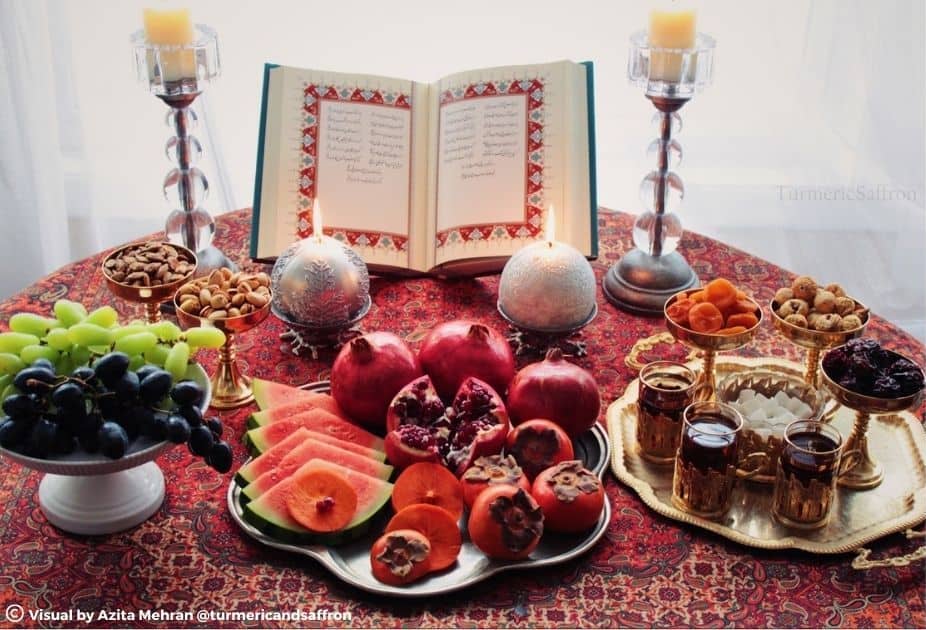
Today, Iranian, Afghan, Tajik, Kurdish, and Azeri communities come together with family and friends to celebrate Shabe Yalda. They gather, usually at the home of grandparents or elderly relatives, to spend the night waiting for the sun to rise with legends, stories, and riddles. They recite verses from the Shahnameh (the epic Book of Kings by Ferdowsi, and the longest poem ever written by a single author) and intone poems from Divan-e Hafez**, accompanied by musical instruments, singing, and delicacies such as – watermelon, persimmon,  pomegranate, and “ajil” ( آجیل), a colorful mix of dried fruits, nuts, and seeds.

According to an old Persian belief, sunrise the following day would break the back of darkness, and with its radiance, remove darkness from people’s lives.

As Persians say… Shabe Yalda Mobarakشب یلدا مبارک – Happy Yalda Night!

Fascinated by Persian traditions, language, and poetry? Get more insight into the culture with NaTakallam’s native instructors! Sign up here, today.


*Fun fact: Did you know the Persian calendar is based on astronomical observations and is considered one of the closest to a perfect calendar according to this and this source? (The months are also aligned with the star signs!)

**Reciting poems from Divan-e Hafez is a special tradition on this night. Each member, in turn, makes a secret wish or poses a secret question (in their heart), and opens a random page in the book, in which the elder member of the family, or best reciter/interpreter, reads the selected poem out loud. It is believed that the randomly selected poem is a response, guidance or direction to the secret wish or question. It is fun to guess the secret wishes of others when in groups, as well!


This piece was contributed by Sayed, our Persian Language Partner, based in Indonesia.

Sayed Mohammad Nabi was born in Afghanistan right after the Soviet withdrawal but has lived as a refugee in Iran and currently resides in Indonesia. He studied French language and literature at Kabul University and has a background in translation and interpretation. In his free time, he enjoys poetry, photography, and hiking. He’s been working with NaTakallam since 2020.

Shabe Yalda: The Longest Night of the Year Read More »

10 Fun Facts About Cinnamon

There’s more to cinnamon than being the perfect holiday spice. Once a prized gift for monarchs and reportedly worth 15x more in value than silver, here are some fun facts proving cinnamon’s history is as rich as its flavor!

1. Cinnamon’s broad range of uses made it invaluable in Ancient Egypt: preserving meat through the winter, treating sore throats, and it was even used as a perfume throughout the embalming process!

2. Cinnamon was an Arab merchant’s best-kept secret! To maintain their monopoly on the spice, they came up with quite the range of stories about their supply source…  

Apparently the 5th century B.C. Greek historian Herodotus recalled people leaving large pieces of ox meat under birds nests, believing large birds carried cinnamon sticks from unreachable mountain tops.


(A concoction of cinnamon, cardamom, and olive oil was used as perfume in Ancient Egypt, maybe even by Cleopatra! via: Daily Mail)

3. Zakaria al-Qazwini – a Persian author and physician of Arab descent – is thought to be the first to mention that the spice is native to Sri Lanka, in his work “آثار البلاد و أخبار العباد” (“Monument of Places and History of God’s Bondsmen”) around 1270.

4. Spanish explorer Gonzalo Pizarro set out to the Amazon hoping to find “pais de la canela” or “cinnamon country” after Christopher Columbus falsely claimed he found cinnamon in the “New World”.

(NPR)

5. Eventually, the Dutch rule over Ceylon (modern-day Sri Lanka) monopolized the cinnamon trade for over 200 years!

(ablekitchen.com)

6. There are two types of cinnamon we know and love today. You probably use cassia cinnamon for your holiday sweets. It’s primarily produced in Vietnam, China and Indonesia – and is the affordable variant. 

But if you want to splurge on true cinnamon, Cinnamomum verum, still produced in Sri Lanka is the way to go! It’s the preferred cinnamon choice in Central America, South America and South Asia and offers a milder, sweeter flavor – perfect for a rich cup of hot chocolate on a winter day!

7. The English word “cinnamon” is derived from the Ancient Greek “κιννάμωμον” (kinnámōmon), via Latin and medieval French. The Ancient Greek term itself is borrowed from a Phoenician word, said to be related to the Hebrew “קינמון‎” (qinnāmōn). In turn, this Hebrew name may come from the Sri Lankan source of the spice, since cinnamon in Singhalese is “kurundu”.

8. Several European languages use some derivation of the Latin “canna”, meaning “tube”, for cinnamon, e.g. French “canelle” and Spanish “canela”. This refers to the curled shape of the spice.

9. Interestingly, since the source of cinnamon was kept secret by early Arab merchants, some falsely believed the spice to be native to China. This explains why some languages refer to cinnamon as a Chinese export, for example “دارچین‎” (daarcheen) in Persian translates literally to “Chinese tree”! (PS. The Turkish word for cinnamon,“tarçın”, and Kurdish “darçîn”, are derived from the Persian, too!)

10. Cinnamon is one of the staple spices used particularly in Arab and Persian cuisines. It’s an element of the Persian spice blend called “ادویه‎” (advieh), as well as used in the delicious Lebanese couscous dish “moghrabieh”, meaning “a dish from the Maghreb”, among others!

Fascinated by the culture and history of word translations and etymologies? Or know someone who is?

Dive deeper with NaTakallam’s Conversation Sessions or give the Gift of Conversation this holiday season to loved ones. Available in Arabic, Persian, Kurdish, French, and Spanish.

10 Fun Facts About Cinnamon Read More »

loading gif

Available Coupon

X