Make Language Access Seamless
Partner with Natakallam to deliver expert, culturally informed interpreting – without the logistical headaches.
Language justice goes beyond communication – it’s about dignity, access, and equitable participation. Explore the global challenges surrounding linguistic exclusion and discover community-centered approaches that prioritize multilingual access and empower displaced individuals.
Advance language justice within your organization.
If today’s global challenges affect us all, why are so many voices still absent from the very conversations meant to solve them?
The UN documented more than 304 million international migrants in 2024, with 123.2 million people forcibly displaced worldwide in the same year. Everyone who takes part in international dialogue arrives with their own story, worldview and cultural background, often shaped by the language they speak. These perspectives, with all the nuances, are what enrich global conversations.
Language Barriers Block Solutions
But can we really claim to tackle the root causes of global crises when entire communities are excluded from the dialogue – often because of the language they speak? International forums may celebrate diversity, yet by relying on only a handful of official languages they miss a critical opportunity to build a truly inclusive and equitable future. This practice mirrors broader patterns of exclusion in global governance: when communication is constrained to the languages of former colonial powers, countless voices are left unheard. Such reliance reflects colonial legacies, where languages of former colonial powers continue to dictate who participates and whose knowledge counts.
When entire communities are silenced, we don’t just lose fairness – we lose the possibility of more innovative, lasting solutions to today’s challenges.
Language is Power
Language is not a technical detail. It is a matter of dignity, justice and care. The United Nations High Commissioner for Refugees (UNHCR) highlights that language differences prevent people from obtaining protection services and reduce their ability to make decisions. Similarly, The World Health Organization (WHO) supports multilingual communication as a vital method to distribute health information fairly while building up worldwide healthcare systems. Studies in humanitarian and medical environments demonstrate that interpreters function as essential professionals who protect fairness in both healthcare teams and humanitarian operations.
The denial of language access results in the denial of power.
Inside Organizations, the Problem Persists
Exclusion does not only occur in global forums or field operations; it also happens within organizations themselves. Bilingual staff members at international NGOs and agencies must perform interpretation duties during meetings while doing their standard work without receiving payment or acknowledgment. The practice diminishes professional value while creating workplace power imbalances, undermining the quality of communication. Organizations should support their staff dignity by using trained interpreters and professional services to achieve both quality communication and fair labor practices.
Language Access as Core Infrastructure
Solutions exist. NaTakallam proves that language access needs to be treated as an integrated and holistic element of core infrastructure which organizations should integrate into their fundamental operations instead of treating it as an extra service. International development and policy settings frequently handle translation and interpretation as secondary considerations which results in reduced equity and effectiveness.
By providing tailored translations and interpretation services to NGOs and institutions, NaTakallam enables organizations to communicate more effectively. Its professional experts combine the translation and interpretation services with professional experts who possess both linguistic skills and cultural understanding, rooted in the Global South and crisis-affected communities. This approach to language justice enhances development initiatives while restoring community control, recognizing local wisdom and enabling meaningful participation in decision-making, as illustrated by UNHCR’s Valencia initiatives where refugee families have been welcomed and integrated through community sponsorship.
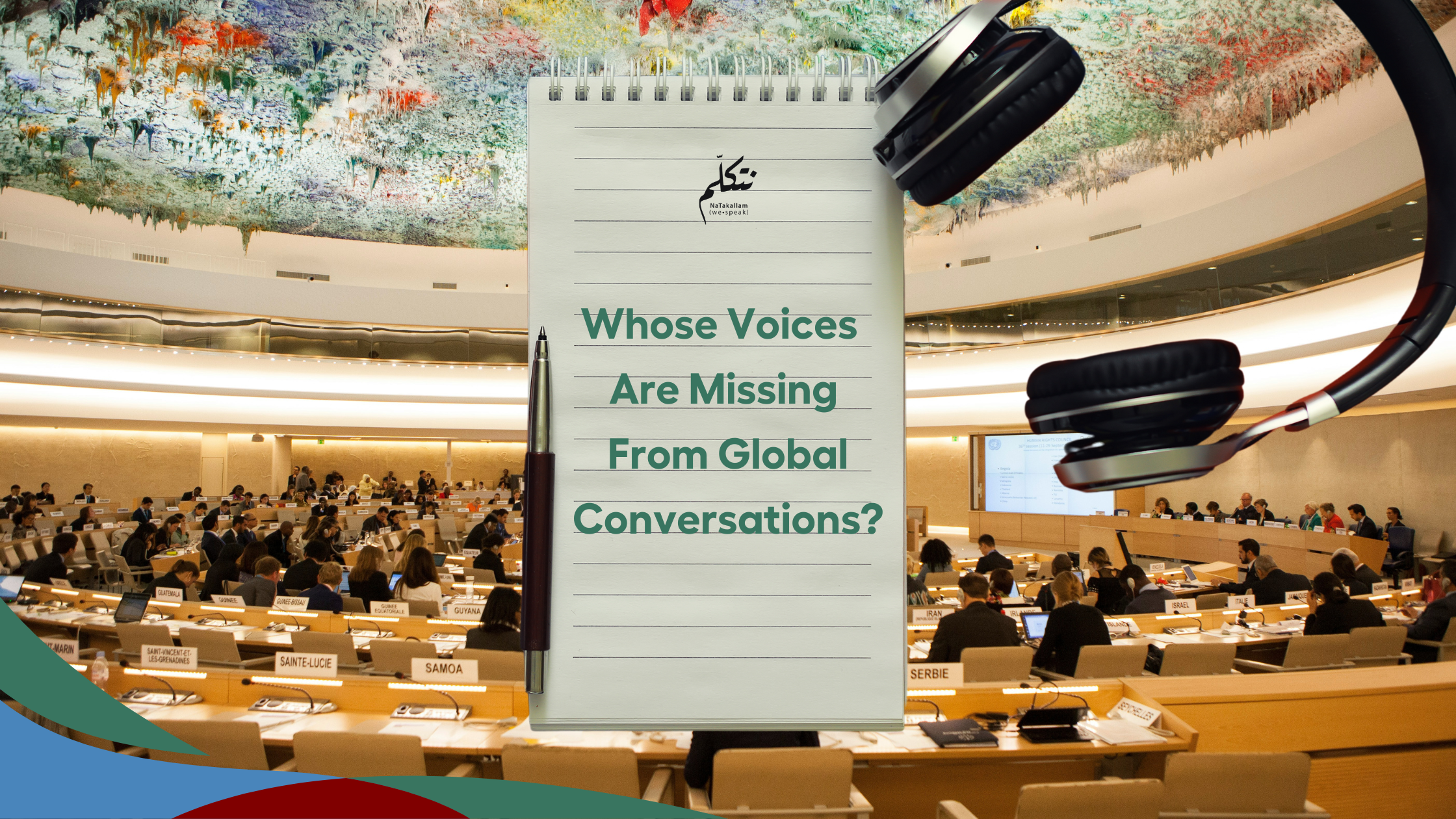
This principle must be applied to global convenings through their actual operational practices. The Human Rights Council at Geneva forces civil society representatives to speak in one of six official languages limiting the ability of community voices to be heard. Such practices reinforce colonial power dynamics, privileging dominant language speakers, while marginalizing local activists and displaced people.
The Power of Removing Language Barriers
The Global Refugee Forum along with other international platforms aim to create stronger partnerships between governments, NGOs, private sector entities and refugees, committing to ensure all voices are represented at decision-making tables. To fulfill that vision, they must treat language justice as fundamental to participation.
Localization as a Pathway
Localization offers a practical pathway forward. The Overseas Development Institute (ODI)’s research shows localization functions as a strategic approach for local practice leadership that operates through power relations while requiring inclusive communication channels. The New Humanitarian warns that external control will continue when international organizations fail to give actual decision-making power to local actors as true empowerment requires them to surrender control to local stakeholders.
NaTakallam enables NGOs to transition from Anglo-centric methods while removing language obstacles which creates space for local voices to evolve from token participation into authentic partnerships.
Language Justice in Action
This is not theoretical. Multiple international organizations and academic institutions have started implementing language justice through their adoption of inclusive language practices. Columbia, Yale and Georgetown universities integrate NaTakallam to provide multilingual learning and cultural exchange programs through refugee language experts who receive proper payment for their work.
The Women Deliver 2023 global conference in Kigali received its interpretation services through NaTakallam which provided both spoken language and International Sign Language support. Organizations such as UNHCR, Save the Children, and OECD, along with NGOs, use NaTakallam for their translation and interpretation and cultural mediation requirements.
A Global Call to Action
Through its model, NaTakallam shows how language justice can materialize with dual impact: by providing displaced individuals with fair compensation as tutors, translators and interpreters, and by supporting organizations in championing meaningful stakeholder participation from grassroots activism and humanitarian aid to high level stakeholder and executive convenings. NaTakallam demonstrates that language inclusion should be both policy and practice through its partnerships with more than 110 countries which serve hundreds of organizations and academic institutions. It´s proof of the transformative power of removing language access barriers to decision-making.
The ability of all voices to participate in meaningful dialogue depends on their ability to be heard. The fight for language access in international meetings serves as a critical test to determine if global governance delivers on its commitment to inclusivity and justice.
NaTakallam partners with NGOs, international organizations and universities to turn this commitment into practice.
Learn More About NaTakallam's Interepretation Services
Are you ready to embed language justice into your convening approach? Discover how our translation, interpretation, and cultural mediation services can ensure that every voice is heard.
Cintia Franco
Cintia Franco is an intern at NaTakallam, currently completing her Bachelor’s degree in International Relations and Business Management in Geneva. She is passionate about cultural exchange.