
Translation

The Rosetta Stone: Unlocking the Secrets of Ancient Egypt

Dive into etymology, history, and more with a NaTakallam language partner

Start learning for FREE!

Discover how a 2000-year-old granite slab in the Egyptian desert opened the world of ancient Egypt to us –and learn how to read a bit of the stélé yourself.

Start learning with a NaTakallam Language Partner in Arabic, Armenian, English, French, Kurdish, Persian, Russian, Spanish or Ukrainian!

Book your 1-on-1 session to start your multilingual journey today.

A Testament in Stone

In 1799, a French soldier digging fortifications near the Egyptian town of Rashid (known by the French as Rosetta) pulled a dark granite stélé from the rubble. Although many stélé had been found, this one was different because it was a bilingual, Egyptian-Greek inscription written in three scripts: Hieroglyphics, Demotic Egyptian, and Greek. 

The Rosetta Stone

Consequently, it proved to be the key to three thousand years of untranslated Egyptian civilization, unlocking the meaning of the Egyptian hieroglyphs. From texts like the Egyptian Book of the Dead to numerous temple inscriptions, the Rosetta Stone was the key to understanding all of them. In addition, the archaeological work that resulted from this text still continues to form the basis of modern Egyptology, with far-reaching ramifications in the fields of history and linguistics.  

It should be noted that for all its fame, the text of the Rosetta Stone was just a government memo: Carved in 196 BCE during the reign of Ptolemy V, it records a priestly decree granting tax exemptions and honors to the king. That is, it’s the ancient world’s equivalent of an official press release. However, what made it a crucial find was that the same text was written in three different scripts, providing a means of decoding the then-lost meaning of Egyptian hieroglyphs. 

Hieroglyphs were the royal, priestly script found in temple walls and royal inscriptions. Note that the terms “hieroglyphs” and “hieroglyphics” are used interchangeably, but generally, hieroglyphics refer to the writing system at large, whereas hieroglyphs refer to the actual symbols used. 

Demotic was the cursive Egyptian script used in everyday handwritten documents, from marketplace transactions to legal documents. Its predecessor was Hieratic, famously used in the Egyptian Book of the Dead

Lastly, the transcription in Ancient Greek reflected the political power ruling Egypt at the time, the Ptolemaic dynasty.

Here’s a summary tracing the stélé’s origins in Memphis to its current housing in the British Museum:


Timeline of the Stélé

196 BCE The stone is carved at Memphis, Egypt, during the reign of Ptolemy V Epiphanes. It is a copy of a decree issued by Egyptian priests who supported the Ptolemaic dynasty. There have been three other nearly identical stelae found since the initial discovery in 1799.
1799 The stone was rediscovered at Rashid (Rosetta), when French soldiers under Napoleon's Egyptian campaign excavated the stone from ancient fort walls near the Nile Delta. Officer Pierre-François Bouchard recognizes its significance.
1801 The British seize the stone after defeating Napoleon's forces. Under the Treaty of Alexandria, it is transferred to London, where it has remained in the British Museum ever since.
1822 Jean-François Champollion cracks the code, working from the Greek text as a guide, and building on earlier work by Thomas Young. The French scholar fully deciphers Egyptian hieroglyphics through the Coptic he learned from the priest Youhanna Chiftichi.

Insight Born of Dedication

"Je me livre entièrement au copte. Je veux savoir l’égyptien comme mon français…"


Jean-François Champollion, the father of modern Egyptology, said in one of his letters: “I devote myself entirely to Coptic. I want to know Egyptian like my French…” The key insight Champollion had was understanding that hieroglyphics were not purely symbolic, as scholars had previously assumed. Employing his knowledge of both Greek and Coptic (the last stage of the Egyptian language), and using the Rosetta Stone as a guide, he was able to understand the hieroglyphic inscriptions.

To illustrate, let’s go through a simplified version of this process, starting with the Greek name of the monarch responsible for the stélé: 

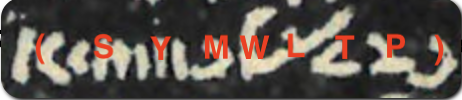
Reading left-to-right, this reads as PTOLEMAIOS, similar to English. Then, in the Demotic part of the stele, this word below corresponds to the above Greek text. The first thing you note is that the left-most and right-most characters seem to bracket the text in between, like cartouches encircle names in hieroglyphs.

Note that in Demotic Egyptian, like in Arabic, not all vowels are written, and words are also written right-to-left. The spelling of Ptolemy can vary in Demotic, so let’s assume it’s ptlwmys. Mapping this to the text would look like: 

So this would be Ptolemy/Ptolemaios in Demotic, with the special brackets that indicate a name. Further, note that Demotic L looks like a modified version of the R character: This is because Egyptian hieroglyphs initially had no separate letter for L. Later on, they used a reclining lion l  (as seen below) to indicate the first letter of Greek ΛΕΩΝ (león). 

Through this method of assigning phonetics to characters, scholars now know that these sounds map onto hieroglyphs in this way:

Another thing to note is that hieroglyphs can be written left-to-right or right-to-left, and you can tell where to begin by following the heads of the animals depicted! In this case, the lion for L faces right, so we read right-to-left.

Connecting Past and Present

Thus, the Rosetta Stone revealed the world behind Egyptian hieroglyphs, and showed the connections between civilizations both remembered and forgotten. For instance, the Demotic Egyptian language on the stone was the direct ancestor of Coptic, a language still used liturgically by the Copts of Egypt. Because Coptic preserved the sounds of ancient Egyptian, Champollion figured out how the old hieroglyphs actually sounded by cross-referencing his work with Coptic.

A Coptic manuscript from Wadi Natrun.

And this work would not have been possible without one of the unsung heroes of this story: The priest Yuhanna Chiftichi, whose Coptic lessons made Champollion’s work possible.

With NaTakallam, you can learn Egyptian Arabic from our native language partners, and likewise open the doors into this fascinating civilization for yourself. Every session is also an act of solidarity, as many of our language partners are displaced, and by booking sessions with NaTakallam, you are supporting their livelihood.

Whether you want to trace the living echo of the ancient world through Egyptian Arabic, other Arabic dialects, French, Spanish, and more, there is a tutor waiting to help you uncover the world behind their language.

Start learning with NaTakallam!

Learn from a wide selection of languages to open up to new worlds, cultures, and histories to explore—all while making a tangible impact.

Daniel Diaz

Share this article on:
Facebook
X
Threads
A Timeline of its Discovery and Decipherment

The Rosetta Stone: Unlocking the Secrets of Ancient Egypt Read More »

View from the interpretation booth at Women Deliver Kigali, 2023

Language Access as Best Practice: Working with Global Majority Interpreters

Make Language Access Seamless

Partner with Natakallam to deliver expert, culturally informed interpreting – without the logistical headaches.

In an interconnected world, effective communication across languages is no longer optional – it is operationally essential. For international organizations engaged in humanitarian response, diplomacy, development, academia, and global convenings, interpreters do far more than transfer words from one language to another.

Work with Natakallam’s Global Majority Interpreters

Set the standard for inclusive, high-quality multilingual events.

Why High-Quality Interpretation Matters for Your Organization

In international humanitarian, diplomatic, and development work, communication is not just about words – it’s about trust, clarity, and inclusion.

Misunderstandings can have serious consequences: broken negotiations, compromised safety, and diminished access to critical services. A 2025 Scoping Review found that displaced populations lose access to healthcare and justice when organizations fail to provide professional interpretation.

High-quality interpretation is an operational and ethical necessity. By investing in professional interpreters, your organization ensures meetings, briefings, and negotiations proceed smoothly and safely, while upholding the highest standards of professionalism.

christina-wocintechchat-com-m-faEfWCdOKIg-unsplash

Preparation is Non-Negotiable

The best outcomes start long before the first word is spoken. Providing interpreters with agendas, reference materials, and glossaries at least three days in advance improves accuracy and efficiency.

Why it matters:

  • Reduces errors during live sessions
  • Helps interpreters manage cognitive load
  • Ensures consistency in technical and sector-specific language

For example, humanitarian organizations rely heavily on acronyms like IDP (Internally Displaced Person), WASH (Water, Sanitation, Hygiene), and GBV (Gender-Based Violence). Unexplained terms create obstacles. Developing a shared Interpreter’s Guide to NGO Terminology ensures your message is accurately conveyed every time.

Respect Interpreter Wellbeing and Working Conditions

Interpreting is cognitively demanding, especially in high-stakes contexts. Cutting corners to save costs ultimately harms the quality of your interpretation. Ethical practices – such as fair compensation and ISO-standard compliant working conditions – protect both your interpreters and your organization.

Best practices include:

  • Rotating interpreters every 15–20 minutes in simultaneous interpretation sessions
  • Providing multiple interpreters per language for long events
  • Supplying appropriate equipment (booths, FM or infrared receivers) for secure on-site or virtual meetings
  • Supporting interpreters with trauma-sensitive training for conflict or crisis-related topics

By prioritizing wellbeing, you reduce fatigue, errors, and stress while fostering a professional environment that enhances collaboration.

Treat Interpreters as Part of Your Team

Interpreters are more than service providers – they are cultural mediators who bridge not only language but context, nuance, and emotion. Including interpreters in pre-event briefings and post-event debriefs builds trust and improves results.

Key considerations:

  • Maintain confidentiality with NDAs and consent for recordings
  • Include interpreters in discussions of cultural and sector sensitivities
  • Recognize the value of their feedback to continuously improve the process

Speak Clearly and Collaborate Effectively

Your delivery directly impacts interpreter performance. Clear, paced speech and prepared materials improve comprehension, particularly in remote or hybrid environments. Small adjustments – avoiding overlaps, using concise phrasing, and sharing materials in advance – enhance accuracy and inclusivity.

Interpreters also facilitate cultural mediation, ensuring your message is not only heard but understood in the appropriate cultural context.

Continuous Feedback and Long-Term Collaboration

High-quality interpretation doesn’t end when the event is over – it thrives on continuous learning and feedback. Organizations that implement structured feedback systems can track:

  • Terminology usage and glossary effectiveness
  • Technical challenges and equipment performance
  • Interpreter team coordination and efficiency

Regular evaluations help maintain smooth operations for online, hybrid, and in-person meetings, ensuring every future event runs more reliably and accurately. Organizations that invest in long-term partnerships with interpreters benefit from consistent results, institutional knowledge, and improved operational efficiency.

Interpretation is not just a service – it is a critical system for equity and inclusion. Without proper language access, social and political processes can break down, leaving participants unheard or misrepresented. Professional interpreters act as cultural mediators, ensuring that every message is accurately conveyed and culturally appropriate. Organizations that respect and invest in interpreters achieve full, respectful voice representation for all participants, creating trust and credibility across languages and borders.

Need tailored interpretation support for your next event?

Explore our Translation & Interpretation FAQs for details on service levels, languages, and delivery timelines. Our team provides personalized guidance to ensure your event’s communication is seamless, secure, and impactful.

Asma Siddiqui

Asma Siddiqui is a copywriting intern at Natakallam with a background in dentistry, gradually transitioning from healthcare into the world of storytelling and strategy. With a deep interest in language, culture, and meaningful communication, she explores how words can shape understanding across communities. When Asma’s not working, you’ll likely find her planning a trip, trying new food, or reflecting through spontaneous writing.

Share this article on:
Facebook
X
Threads

Language Access as Best Practice: Working with Global Majority Interpreters Read More »

Language Justice in global conversation

How Language Justice Can Unlock Fairer Global Solutions

Make Language Access Seamless

Partner with Natakallam to deliver expert, culturally informed interpreting – without the logistical headaches.

Language justice goes beyond communication – it’s about dignity, access, and equitable participation. Explore the global challenges surrounding linguistic exclusion and discover community-centered approaches that prioritize multilingual access and empower displaced individuals.

If today’s global challenges affect us all, why are so many voices still absent from the very conversations meant to solve them?

The UN documented more than 304 million international migrants in 2024, with 123.2 million people forcibly displaced worldwide in the same year. Everyone who takes part in international dialogue arrives with their own story, worldview and cultural background, often shaped by the language they speak. These perspectives, with all the nuances, are what enrich global conversations.

Language Barriers Block Solutions

But can we really claim to tackle the root causes of global crises when entire communities are excluded from the dialogue – often because of the language they speak? International forums may celebrate diversity, yet by relying on only a handful of official languages they miss a critical opportunity to build a truly inclusive and equitable future. This practice mirrors broader patterns of exclusion in global governance: when communication is constrained to the languages of former colonial powers, countless voices are left unheard. Such reliance reflects colonial legacies, where languages of former colonial powers continue to dictate who participates and whose knowledge counts.

When entire communities are silenced, we don’t just lose fairness – we lose the possibility of more innovative, lasting solutions to today’s challenges.

Language is Power

Language is not a technical detail. It is a matter of dignity, justice and care. The United Nations High Commissioner for Refugees (UNHCR) highlights that language differences prevent people from obtaining protection services and reduce their ability to make decisions. Similarly, The World Health Organization (WHO) supports multilingual communication as a vital method to distribute health information fairly while building up worldwide healthcare systems. Studies in humanitarian and medical environments demonstrate that interpreters function as essential professionals who protect fairness in both healthcare teams and humanitarian operations.

The denial of language access results in the denial of power.

Inside Organizations, the Problem Persists

Exclusion does not only occur in global forums or field operations; it also happens within organizations themselves. Bilingual staff members at international NGOs and agencies must perform interpretation duties during meetings while doing their standard work without receiving payment or acknowledgment. The practice diminishes professional value while creating workplace power imbalances, undermining the quality of communication. Organizations should support their staff dignity by using trained interpreters and  professional services to achieve both quality communication and fair labor practices.

Language Access as Core Infrastructure

Solutions exist. NaTakallam proves that language access needs to be treated as an integrated and holistic element of core infrastructure which organizations should integrate into their fundamental operations instead of treating it as an extra service. International development and policy settings frequently handle translation and interpretation as secondary considerations which results in reduced equity and effectiveness. 

By providing tailored translations and interpretation services to NGOs and institutions, NaTakallam enables organizations to communicate more effectively. Its professional experts combine the translation and interpretation services with professional experts who possess both linguistic skills and cultural understanding, rooted in the Global South and crisis-affected communities. This approach to language justice enhances development initiatives while restoring community control, recognizing local wisdom and enabling meaningful participation in decision-making, as illustrated by UNHCR’s Valencia initiatives where refugee families have been welcomed and integrated through community sponsorship. 

This principle must be applied to global convenings through their actual operational practices. The Human Rights Council at Geneva forces civil society representatives to speak in one of six official languages limiting the ability of community voices to be heard. Such practices reinforce colonial power dynamics, privileging dominant language speakers, while marginalizing local activists and displaced people.

The Power of Removing Language Barriers

The Global Refugee Forum along with other international platforms aim to create stronger partnerships between governments, NGOs, private sector entities and refugees, committing to ensure all voices are represented at decision-making tables. To fulfill that vision, they must treat language justice as fundamental to participation.

Localization as a Pathway

Localization offers a practical pathway forward. The Overseas Development Institute (ODI)’s research shows localization functions as a strategic approach for local practice leadership that operates through power relations while requiring inclusive communication channels. The New Humanitarian warns that external control will continue when international organizations fail to give actual decision-making power to local actors as true empowerment requires them to surrender control to local stakeholders. 

NaTakallam enables NGOs to transition from Anglo-centric methods while removing language obstacles which creates space for local voices to evolve from token participation into authentic partnerships.

Language Justice in Action

This is not theoretical. Multiple international organizations and academic institutions have started implementing language justice through their adoption of inclusive language practices. Columbia, Yale and Georgetown universities integrate NaTakallam to provide multilingual learning and cultural exchange programs through refugee language experts who receive proper payment for their work. 

The Women Deliver 2023 global conference in Kigali received its interpretation services through NaTakallam which provided both spoken language and International Sign Language support. Organizations such as  UNHCR, Save the Children, and OECD, along with NGOs, use NaTakallam for their translation and interpretation and cultural mediation requirements.

A Global Call to Action

Through its model, NaTakallam shows how language justice can materialize with dual impact:  by providing displaced individuals with fair compensation as tutors, translators and interpreters, and by supporting organizations in championing meaningful stakeholder participation from grassroots activism and humanitarian aid to high level stakeholder and executive convenings. NaTakallam demonstrates that language inclusion should be both policy and practice through its partnerships with more than 110 countries which serve hundreds of organizations and academic institutions. It´s proof of the transformative power of removing language access barriers to decision-making.

The ability of all voices to participate in meaningful dialogue depends on their ability to be heard. The fight for language access in international meetings serves as a critical test to determine if global governance delivers on its commitment to inclusivity and justice. 

NaTakallam partners with NGOs, international organizations and universities to turn this commitment into practice.

Learn More About NaTakallam's Interepretation Services

Are you ready to embed language justice into your convening approach? Discover how our translation, interpretation, and cultural mediation services can ensure that every voice is heard.

Cintia Franco

Cintia Franco is an intern at NaTakallam, currently completing her Bachelor’s degree in International Relations and Business Management in Geneva. She is passionate about cultural exchange.

Share this article on:
Facebook
X
Threads

How Language Justice Can Unlock Fairer Global Solutions Read More »

loading gif

Available Coupon

X