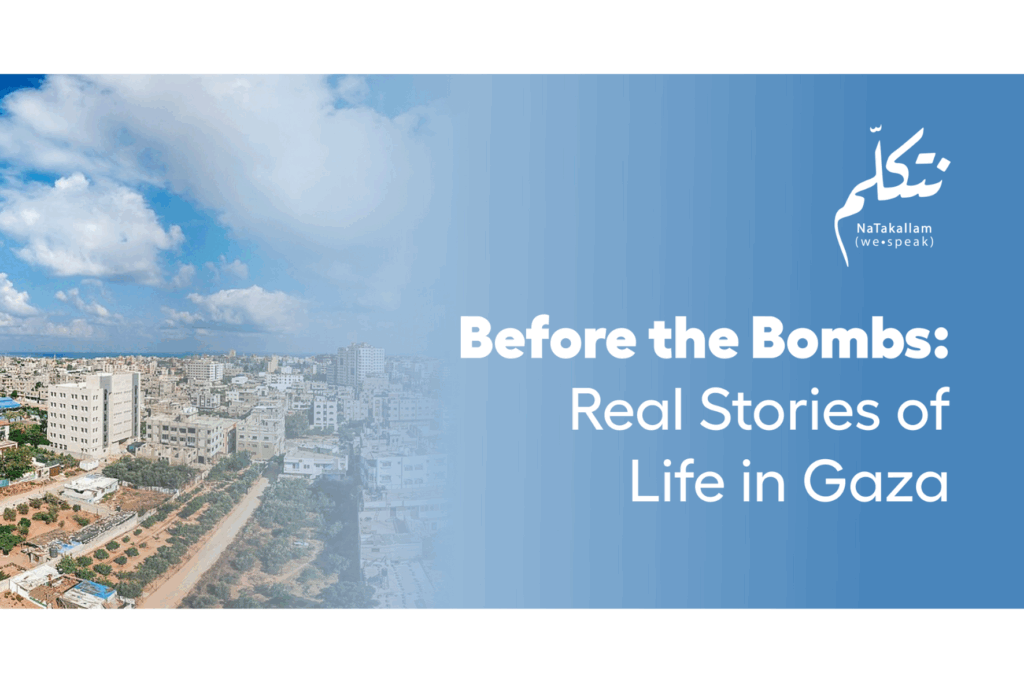
Before the Bombs: Real Stories of Life in Gaza
Late March in Khan Younis, Gaza, smells like citrus.
You’d only notice it if you were out walking, preferably at night, when the air is cool and the gardens are in bloom. When it rains – just lightly – the blossoms release their oils and the scent intensifies.
“Gaza was always incredibly green; its inhabitants connected to nature,” recalls Dalia, a NaTakallam language partner from Khan Younes who once walked those citrus-lined streets, whose weekends were spent in crowded restaurants, whose Friday mornings began with fresh hummus and ended barefoot by the sea.
Shahd, another woman from Gaza now displaced by war, echoes this connection. For her, the sounds and scents of Gaza live just as vividly in memory: the call of the bouza (ice-cream) trucks, the chaotic laughter of the marketplace, and the salty scent of the Mediterranean Sea, especially down at the port. “Even the drama of the streets,” she says, “the fighting drivers – I miss it all.”
Both women are now far from home – Dalia in Cairo, Shahd having briefly found refuge in Egypt before continuing her journey to the States. They were forced to flee to a new home, but like many Gazans, their hearts live elsewhere.
Croissants, Smoothies and Knafeh
In the heart of Gaza City stood MAZZAG, famous for its croissants – “the best in Gaza,” Dalia says, with a smile that tells you it’s less about the pastry and more about the memories folded into it.
For Shahd, it was Ristretto Coffee Lab – a cozy, eco-conscious café that served up international dishes like tiramisu. “They even reused coffee grounds and materials and had a very sustainable business model” she recalls. It was a place where she saw her city evolving, despite everything. “Even under siege, we had people innovating, succeeding. The owner was lucky enough to be allowed to travel for educational purposes, and brought back ideas. That meant something to all of us.”
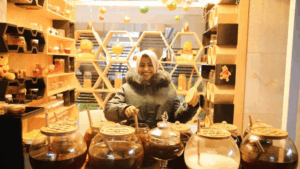
After shopping, the ritual was the same for Dalia: a citrusy barrad (smoothie) from Kazem, then dinner at Al Dar – kebabs and mixed grills, always shared. For Shahd, Gaza’s beachfront restaurants were a favorite: Abu Hassira and many more – each serving fresh fish, each with a front-row seat to the sea. One, she noted, sat right next to one of Gaza’s most beautiful mosques, Masjid al-Mina.
This is the Gaza few outsiders knew: full of flavor, full of laughter, full of life.
Fridays Were For Family, Food and the Sea
Friday, the only day off from school, was sacred. For Dalia, it meant hummus from Abu Zahran in the quiet morning, then the mosque, then home for a big family meal. The afternoons were for grandparents. The evenings? Always spent at the sea.
Families would stay until midnight, drinking tea brewed over a wood fire, letting the wind carry away the week’s heaviness. “Everyone knew everyone,” she said. “It always felt like you were among family.”
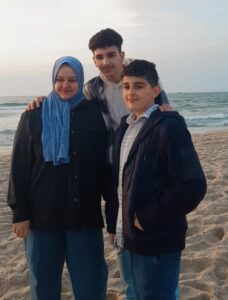
Shahd remembers the Old Town of Gaza – its mosques and churches, the gold shops buzzing during Ramadan. Places like Masjid al-Omari, Qasr al-Basha, and the Al Qarara Cultural Museum held layers of history and community pride. Now, most of those sites are gone. Still, in her mind, they stand.
What Was Lost
When asked what they miss most, both women give the same answer without hesitation: home.
But not just a house – a home built with your own hands or your father’s, with tiles you chose, trees you planted, stories told across the threshold. “It’s a connection to your fatherland,” says Dalia. “To be deprived of that – of what you built, what you grew up in – it’s a kind of pain you can’t describe.”
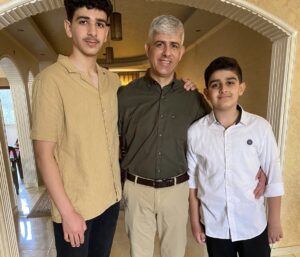
Shahd, too, describes this ache. Once, in America, she found herself paying $6 for a cup of tea at a Palestinian restaurant. “In Gaza, I never would have done that,” she laughs. “But at that moment, it felt like home. Your need for your identity intensifies when you’re far away from it.”
If They Could Go Back
Dalia, despite all the hardship she went through, can still joke. The first thing she would do is ta3zeel – Arabic for deep cleaning the house. The sad reality is that her house probably is not standing anymore. At least, the last update she had was that it was hit by a blast.
In fact, Dalia’s first visit back home would be to the cemetery.
She wants to see her father’s grave, to say goodbye – if it’s still there.
“There’s no starting over without closure,” she says. “It will be hard to see the ruins. But it is necessary to end this chapter, start over and move on.”
Shahd’s dream is gentler. “If it were the Gaza I knew, I’d go to the port first,” she says. Then she’d visit her favorite places, call her friends – the ones who are still alive – and gather them for a big meal. “I’d like to apologize to them,” she says softly. “I felt guilty for leaving during such a hard time. So I’d do something meaningful. Teach English. Run activities. Contribute.”
The sense of community in Gaza is unlike what both women have seen anywhere else in the world. A lifeline when things got hard.
“We needed each other. Pain made us closer,” Shahd explains. “In Gaza, when someone suffered, everyone showed up. That kind of unity… it’s rare. It’s probably the reason we are still so strong.”
A Future Build on Survival
“I want to be realistic when talking about my dreams for Gaza.” says Dalia. “Every family has lost so much. I just want people to have the right to survive. To live.”
Shahd adds: “People always romanticize us or reduce us. Either we’re heroes or we’re threats. But we’re human. We’re suffering. We’re also dreaming.”
Dreaming of studying French.
Of opening bakeries.
Of walking barefoot by the sea.
Of tea shared, stories told, waves crashing gently at the port.
Of silence. No bombs, no trauma, no death – just life.
Language, Memory & Survival
At NaTakallam, we connect people like Dalia and Shahd – displaced but not voiceless – with learners around the world. Through conversation, they share not only their language, but their stories, their culture, their memories of home.
When you speak with someone from Gaza, you’re not just learning Arabic.
You’re learning what it means to carry identity in exile.
You’re learning what resilience sounds like.
You’re learning what it means to hold onto hope.
If you’d like to learn Palestinian Arabic – or several other dialects including Modern Standard Arabic – while directly supporting displaced people like Shahd and Dalia, NaTakallam’s Language Partners are waiting! Sign up for a free trial and discover the joys of language learning with a private tutor, on your own schedule.
ABOUT THE AUTHOR: Zeina Abou Taha is an intern at NaTakallam, currently transitioning from a career in IT consulting into journalism. With an academic background in Entrepreneurship & Innovation and a passion about exploring the world, Zeina spends her free time traveling, connecting with people from diverse cultures, and writing for her personal blog.
Before the Bombs: Real Stories of Life in Gaza Read More »

 Marianela
 Abir,
Abir,
