NATAKALLAM BLOG

The Rosetta Stone: Unlocking the Secrets of Ancient Egypt

Dive into etymology, history, and more with a NaTakallam language partner

Start learning for FREE!

Discover how a 2000-year-old granite slab in the Egyptian desert opened the world of ancient Egypt to us –and learn how to read a bit of the stélé yourself.

Start learning with a NaTakallam Language Partner in Arabic, Armenian, English, French, Kurdish, Persian, Russian, Spanish or Ukrainian!

Book your 1-on-1 session to start your multilingual journey today.

A Testament in Stone

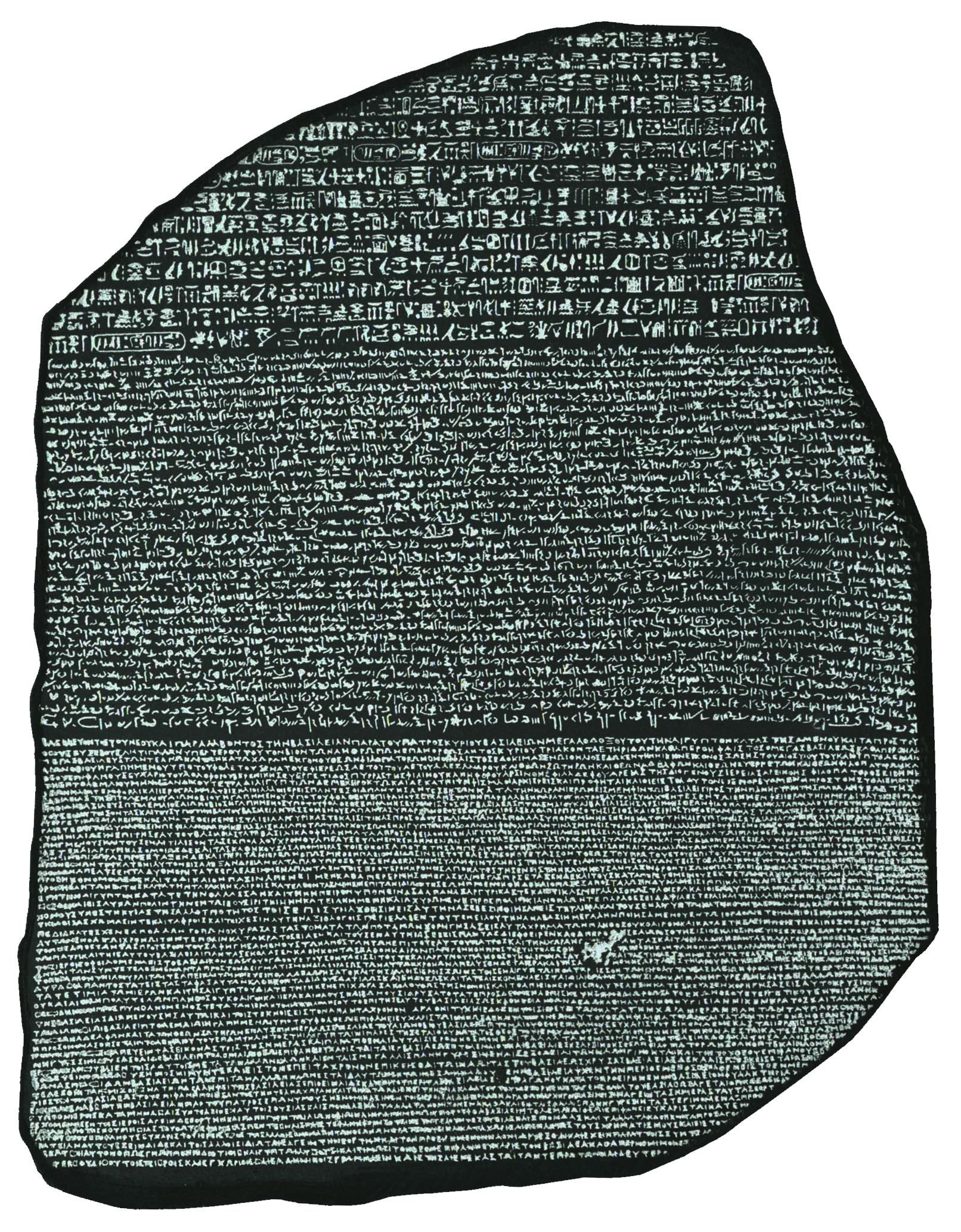
In 1799, a French soldier digging fortifications near the Egyptian town of Rashid (known by the French as Rosetta) pulled a dark granite stélé from the rubble. Although many stélé had been found, this one was different because it was a bilingual, Egyptian-Greek inscription written in three scripts: Hieroglyphics, Demotic Egyptian, and Greek. 

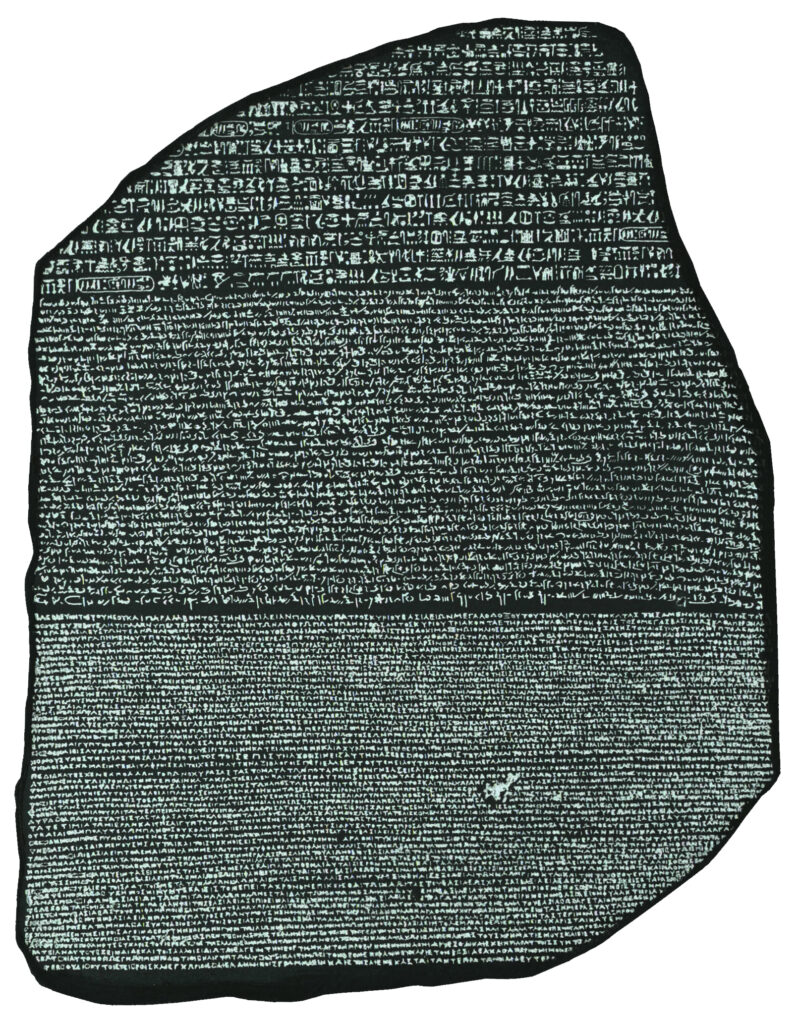
The Rosetta Stone

Consequently, it proved to be the key to three thousand years of untranslated Egyptian civilization, unlocking the meaning of the Egyptian hieroglyphs. From texts like the Egyptian Book of the Dead to numerous temple inscriptions, the Rosetta Stone was the key to understanding all of them. In addition, the archaeological work that resulted from this text still continues to form the basis of modern Egyptology, with far-reaching ramifications in the fields of history and linguistics.  

It should be noted that for all its fame, the text of the Rosetta Stone was just a government memo: Carved in 196 BCE during the reign of Ptolemy V, it records a priestly decree granting tax exemptions and honors to the king. That is, it’s the ancient world’s equivalent of an official press release. However, what made it a crucial find was that the same text was written in three different scripts, providing a means of decoding the then-lost meaning of Egyptian hieroglyphs. 
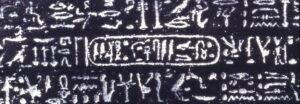
Hieroglyphs were the royal, priestly script found in temple walls and royal inscriptions. Note that the terms “hieroglyphs” and “hieroglyphics” are used interchangeably, but generally, hieroglyphics refer to the writing system at large, whereas hieroglyphs refer to the actual symbols used. 
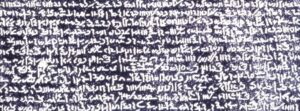
Demotic was the cursive Egyptian script used in everyday handwritten documents, from marketplace transactions to legal documents. Its predecessor was Hieratic, famously used in the Egyptian Book of the Dead

Lastly, the transcription in Ancient Greek reflected the political power ruling Egypt at the time, the Ptolemaic dynasty.

Here’s a summary tracing the stélé’s origins in Memphis to its current housing in the British Museum:

Timeline of the Stélé

196 BCE The stone is carved at Memphis, Egypt, during the reign of Ptolemy V Epiphanes. It is a copy of a decree issued by Egyptian priests who supported the Ptolemaic dynasty. There have been three other nearly identical stelae found since the initial discovery in 1799.
1799 The stone was rediscovered at Rashid (Rosetta), when French soldiers under Napoleon's Egyptian campaign excavated the stone from ancient fort walls near the Nile Delta. Officer Pierre-François Bouchard recognizes its significance.
1801 The British seize the stone after defeating Napoleon's forces. Under the Treaty of Alexandria, it is transferred to London, where it has remained in the British Museum ever since.
1822 Jean-François Champollion cracks the code, working from the Greek text as a guide, and building on earlier work by Thomas Young. The French scholar fully deciphers Egyptian hieroglyphics through the Coptic he learned from the priest Youhanna Chiftichi.

Insight Born of Dedication

"Je me livre entièrement au copte. Je veux savoir l’égyptien comme mon français…"


Jean-François Champollion, the father of modern Egyptology, said in one of his letters: “I devote myself entirely to Coptic. I want to know Egyptian like my French…” The key insight Champollion had was understanding that hieroglyphics were not purely symbolic, as scholars had previously assumed. Employing his knowledge of both Greek and Coptic (the last stage of the Egyptian language), and using the Rosetta Stone as a guide, he was able to understand the hieroglyphic inscriptions.

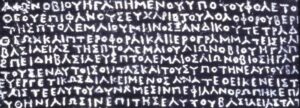
To illustrate, let’s go through a simplified version of this process, starting with the Greek name of the monarch responsible for the stélé: 

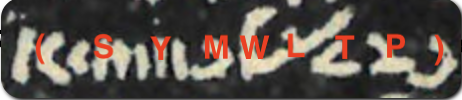
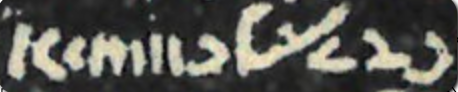
Reading left-to-right, this reads as PTOLEMAIOS, similar to English. Then, in the Demotic part of the stele, this word below corresponds to the above Greek text. The first thing you note is that the left-most and right-most characters seem to bracket the text in between, like cartouches encircle names in hieroglyphs.

Note that in Demotic Egyptian, like in Arabic, not all vowels are written, and words are also written right-to-left. The spelling of Ptolemy can vary in Demotic, so let’s assume it’s ptlwmys. Mapping this to the text would look like: 

So this would be Ptolemy/Ptolemaios in Demotic, with the special brackets that indicate a name. Further, note that Demotic L looks like a modified version of the R character: This is because Egyptian hieroglyphs initially had no separate letter for L. Later on, they used a reclining lion l  (as seen below) to indicate the first letter of Greek ΛΕΩΝ (león). 

Through this method of assigning phonetics to characters, scholars now know that these sounds map onto hieroglyphs in this way:
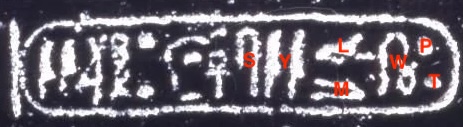
Another thing to note is that hieroglyphs can be written left-to-right or right-to-left, and you can tell where to begin by following the heads of the animals depicted! In this case, the lion for L faces right, so we read right-to-left.

Connecting Past and Present

Thus, the Rosetta Stone revealed the world behind Egyptian hieroglyphs, and showed the connections between civilizations both remembered and forgotten. For instance, the Demotic Egyptian language on the stone was the direct ancestor of Coptic, a language still used liturgically by the Copts of Egypt. Because Coptic preserved the sounds of ancient Egyptian, Champollion figured out how the old hieroglyphs actually sounded by cross-referencing his work with Coptic.
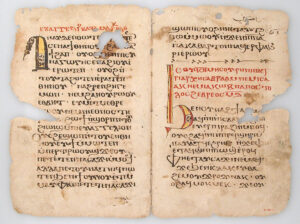
A Coptic manuscript from Wadi Natrun

And this work would not have been possible without one of the unsung heroes of this story: The priest Yuhanna Chiftichi, whose Coptic lessons made Champollion’s work possible.

With NaTakallam, you can learn Egyptian Arabic from our native language partners, and likewise open the doors into this fascinating civilization for yourself. Every session is also an act of solidarity, as many of our language partners are displaced, and by booking sessions with NaTakallam, you are supporting their livelihood.

Whether you want to trace the living echo of the ancient world through Egyptian Arabic, other Arabic dialects, French, Spanish, and more, there is a tutor waiting to help you uncover the world behind their language.

Start learning with NaTakallam!

Learn from a wide selection of languages to open up to new worlds, cultures, and histories to explore—all while making a tangible impact.

Daniel Diaz

Share this article on:
Facebook
X
Threads
A Timeline of its Discovery and Decipherment

Try Our Lessons:

BOOK

3

HOURS
OF SESSIONS

Choose from Arabic, Armenian, English, French, Kurdish, Persian, Russian, Spanish or Ukrainian.

BOOK

10

HOURS
OF SESSIONS

Choose from Arabic, Armenian, English, French, Kurdish, Persian, Russian, Spanish or Ukrainian.

BOOK

20

HOURS
OF SESSIONS

Choose from Arabic, Armenian, English, French, Kurdish, Persian, Russian, Spanish or Ukrainian.

BOOK

30

HOURS
OF SESSIONS

Choose from Arabic, Armenian, English, French, Kurdish, Persian, Russian, Spanish or Ukrainian.

YOU MIGHT ALSO LIKE:

loading gif

Available Coupon

X