Purposeful Learning / Social Impact

5 Incredible Latin American Feminists You Need To Know

Blog contributor: Maria Thomas

Women’s History Month or any day of the year, here are 5 Latin American feminists you need to know and celebrate!

1. Frida Kahlo (Mexico, 1907-1954)

Frida Kahlo was a Mexican artist known for her paintings that explored themes of female subjectivity, sexuality and marginality. Through her highly symbolic canvases, many of which were built around her own self-portraits – for example, Self-Portrait with Cropped Hair, Self-Portrait with Thorn Necklace and Hummingbird – Kahlo eschewed gender stereotypes and gave voice to often taboo aspects of femininity.

2. Excilia Saldaña (Cuba, 1946-1999)

Excilia Saldaña was an award-winning Cuban essayist, poet, translator, academic and author of children’s books. Her works – including the book, La Noche (‘The Night’), poems such as My Name (A Family Anti Elegy) and short stories like Kele Kele – were very important contributions to the creation and consolidation of a tradition of Afro-Hispanic women writers and artists.

3. Cecilia Vicuña (Chile, 1948-)

Cecilia Vicuña is a Chilean poet and multidisciplinary artist. Her works, which include collections of poems such as Precario/Precarious (1973) and Unravelling Words and Weaving Water (1992), and art installations such as Could-Net and Quipu Menstrual, are grounded in her understanding that the political, environmental and indigenous are inherently connected and must be addressed as such. Also, central to Vicuña’s works are her explorations of the connections between gendered injustice and environmental despoliation.

4. Selva Almada (Argentina, 1973-)

Selva Almada is an Argentinian writer who is considered one of the most powerful voices of contemporary Argentinian and Latin American literature. She is also recognised as one of the most influential feminist intellectuals of the region. Her works, particularly her book,  Dead Girls – originally published originally in Spanish as Chicas Muertas in 2014 – highlight issues such as gendered violence, femicide and the legal inadequacies of Argentinian legal systems in addressing them.

5. Clarice Lispector (Brazil, 1920-1977)

Clarice Lispector was an Ukranian-born Brazillian novelist and short-story writer. Her family fled Western Ukraine to escape the pogroms that followed World War I and the Russian Civil War. Her works written in Portuguese include short story collections such as Laços de família (‘Family Ties’) and Para não esquecer (‘Not to Forget’), and novels such as Perto do coração selvagem (translated and published in English as Near to the Wild Heart), A Paixão segundo G.H. (translated and published in English as The Passion According to G.H.). French feminist writer Hélène Cixous credits her works with “exploring women’s identity with a depth that no one has achieved until now”.

Learn Spanish and explore the worlds of these inspirational women with NaTakallam!

We are a women-led and women-fueled community that offers language sessions in Spanish, among other languages. Our Latin American native language tutors are individuals who have been displaced from countries like Venezuela, Nicaragua, and Guatemala, and are currently resettled in neighboring countries such as Uruguay, Costa Rica, the United States, Ecuador, Trinidad and Tobago, and Argentina. 

Brush up your Spanish skills, delve into Latin American cultures and experiences, and celebrate these incredible women, today and everyday!


This piece was contributed by Maria Thomas, a copywriter with NaTakallam. She is currently pursuing her doctoral studies in art history. In her spare time, she enjoys reading, powerlifting and going on hikes.

5 Incredible Latin American Feminists You Need To Know Read More »

3 Reasons Why The Gift of Language Is The Ultimate Gift


On a quest for a meaningful gift for a loved one? Look no further. Online language lessons are the ultimate gift for a culture aficionado or a perennially curious language enthusiast in your life. Perfect for birthdays, holidays, and special occasions.

Plus, it’s shipping-free, impact-driven and starts at only US$25.

1. IT NOURISHES YOUR MIND

Learning a language physically changes your mind – making one a stronger, more creative thinker. A study at the University of Edinburgh demonstrated that young adults proficient in two languages performed better on attention tests and had better concentration than those who spoke only one language. The study also showed that adults who had become bilingual later in life performed better than those who had not – exhibiting more robust general intelligence and thinking abilities. 

Learning a new language can make you a better listener. A study at Northwestern University found that bilinguals are better at juggling linguistic input, instinctively paying more attention to relevant sounds and ignoring irrelevant ones – making them more effective in challenging or novel listening conditions. 

Language learning is essentially a workout for your mind. It challenges it in order to keep it sharp and cognizant. It mustn’t be surprising then that language learning is an effective therapy to help delay the onset of neurological disorders such as Alzheimer’s.

2. IT NOURISHES YOUR SOUL

Learning a new language provides an avenue to explore new and exciting cultures that ignites the soul! It helps one to interact with people from around the world and acquaint oneself with their experiences. This can help broaden one’s perspective in ways that many other educational experiences cannot. Dan Roitman points out that ‘‘as a language learner, you’ll not only become a more conscious thinker and listener who can communicate clearly and think creatively, but you’ll also gain the most significant benefit of multilingualism: a broader, more global perspective.’’ 

Learning a new language can also help transcend political, geographical and cultural boundaries. It encourages one to try to comprehend experiences that are remote from their own, develop a sense of empathy and work towards the common good, and go beyond headline narratives. The people, stories, and experiences that a new language brings you truly has the potential to nourish your soul!

3. IT NOURISHES YOUR HEART

When you learn a new language on platforms such as NaTakallam, you not only nourish your mind and soul but also your heart! NaTakallam leverages the freelance digital economy to provide income to refugees, displaced persons and their host communities by hiring them as online tutors, teachers, translators and cultural exchange partners, regardless of their location and status. Learning a new language with NaTakallam allows one to connect to local cultures, initiate cross-border friendships and have a holistic language-learning experience that’s good for your mind, soul and heart! 

Give your loved one a unique language-learning experience with NaTakallam’s Gift of Language and Conversation. Available in Arabic, Armenian, English, French, Kurdish, Persian, Spanish, and suitable for all ages and levels.

What’s more? NaTakallam’s language sessions take place virtually from the comforts of home and make the perfect last-minute (yet meaningful) gift that requires no shipping. Gift a language, surprise a loved one, change a life.

3 Reasons Why The Gift of Language Is The Ultimate Gift Read More »

Gift Guide: 6 Social Enterprises that Support Refugees


It’s that time of year again! This holiday season, kill two birds with one stone by considering impact-driven gifts for your loved ones. Make a difference with our list of 6 social enterprises that support the talents, skills, and livelihood of displaced persons – refugees, asylum seekers, and migrants – through their unique and thoughtfully-collated products that will leave a lasting impression (and impact).


1. MADE51 | Starting from £12 

MADE51 is a UNHCR initiative that connects refugee artisans to global markets. It is a lifestyle brand selling beautiful home decor and fashion items that merge contemporary design with traditional craftsmanship. Each product in the MADE51 collection is handcrafted by a refugee artisan who lives in a hosting country in Africa, Asia, Europe, or the Middle East. Whether it is their Amaryllis Basket, crafted by Burundian refugees living in Rwanda, or their Gold Glow Nuusum Statement Earrings, crafted by refugees from Myanmar, Syria, and Afghanistan living in Malaysia – each piece in this collection tells a story of skill and perseverance and would make a perfect stocking filler this holiday season! 

MADE51 offers flat-rate worldwide shipping and free shipping with a minimum purchase spend. Find out more here.


2. Migrateful | Starting from £20 | Digital Gift Option

Migrateful is a social enterprise based in London that gives asylum seekers and refugees looking for jobs in the UK a space to share recipes from their countries, their culture, language and stories through cookery classes – in person or digital. They also receive professional training and English-language lessons. Participants in these classes can learn recipes from all over the world from chefs coming from: Afghanistan, Iran, Lebanon, Egypt, Tunisia, Albania, Eritrea, Ethiopia, Nigeria, Pakistan, Bangladesh, Cuba and Ecuador. Migrateful’s online or in-person cookery classes are an ideal gift for foodies and culture enthusiasts in your life, near or far!

The Migrateful cookery classes can take place in-person in London, Bristol, Kent or Brighton or online on Zoom. Shipping-free and guaranteed fun with impact.


3. Sisterhood Soap | Preemptive Love | Starting from US$10

Looking for gifts that are good for your skin, the environment, and the world? Preemptive Love’s Sisterhood Soap, hand-milled by refugees in Iraq, using natural and sustainable ingredients will not disappoint. They use natural ingredients such as 100% pure olive oil and wild grown herbs. Their motto for the latter is: if it hasn’t been grown wild for hundreds of years, don’t use it! Sisterhood Soap does not use any dyes, artificial fragrance, glycerine, sulfates or parabens – making it safe for all skin-types. In choosing their individual soaps, gift sets, or their quarterly soap subscription, you’re empowering a refugee soapmaker and growing the sisterhood! 

Rebuild lives one bar at a time. Preemptive Love ships worldwide from the US. Shipping rates and times will vary according to items, courier and location.


4. Anchor of Hope Box | Starting from US$36

The Anchor of Hope Box is a monthly subscription box filled with original, lifestyle items handmade by refugees, survivors of human trafficking and other vulnerable situations. In doing so, they endeavor to give hope and dignity to individuals who are working to overcome poverty and injustice that has impacted their lives. The monthly subscription boxes include well-thought-out and researched products ranging from jewelry, ceramics, art works to home decor and spices. Each month, the subscription box will contain 3 quality, handmade items as well as an information card about the products and the artisans that made them. Gift a loved one an Anchor of Hope Box this holiday season and share the joy of a gift that keeps giving! 

Anchor of Hope Box currently only ships to the US. Shipping rates and times may vary according to the location.


5. SEP Jordan | Starting from €35

A Swiss-based social enterprise, SEP Jordan is a luxury fashion & lifestyle business with a social impact focus. Its mission is to bring thousands of refugees, located in the Jerash “Gaza” Camp in Jordan, above the poverty line: by leveraging their skills and talent in hand embroidery. They currently work with over 500 embroidery artists, mostly women, enabling them to regain their economic and emotional independence. Their hand-embroidered keffiyehs (كوفية‎), beautiful cashmere shawls, and bespoke accessories, all packed with love and heritage, would make quality gifts for loved ones. Additionally, they offer Gift Card options starting from €50. 

SEP Jordan ships worldwide via DHL Express. Shipping rates and times may vary according to the location.


6. NaTakallam | Starting from $25 | Digital Gift 

Last, but not least, NaTakallam is an award-winning social enterprise that pairs language learners with native tutors from refugee backgrounds for one-on-one online lessons! You can choose from an array of languages – including Arabic, Armenian, Kurdish, Persian, French and Spanish – and gift packages to fit your budget. With NaTakallam’s language sessions you can give your loved one an experience of a language and culture while also supporting the livelihood of tutors from displaced backgrounds and their host communities. It makes a perfect stocking stuffer for a beloved language-enthusiast looking for a life-changing experience (both theirs and their tutors alike)!

Give the Gift of Conversation to a language lover in your life, near or far. Suitable for all levels and ages. This gift is paperless and shipping-free (i.e it can be “virtually” shipped worldwide).

Gift Guide: 6 Social Enterprises that Support Refugees Read More »

5 Ways to Change the World — Even Under Lockdown

Lockdown, round 2? 

Believe it or not, that act of staying indoors—in itself—is saving lives. 

As we continue to experience pressure these days – worrying news worldwide, anxiety about an even greater winter Covid-wave and, getting used to remote work (again) – something remains unchanged: the aspiration to make a difference.

Here are our – non-exhaustive – suggestions of 5 great ways to change the world from home.

1. Support worthwhile causes

While many of us are taking a financial toll due to the new restrictions, others are fortunate to be able to continue working from home, business (almost) as usual. If you’ve saved cash from skipping restaurants or shopping, consider donating to cause or browsing the web for holiday gifts with a cause.

There are plenty of phenomenal organizations to choose from, and many have lost funding due to a shift towards covid-related initiatives.

→ CharityWatch provides a topic-based list.

2. Grow your own urban balcony garden

Grow your own urban balcony garden. Pollution in many areas under full lockdown went down earlier this year, so while we breathe cleaner air, the climate crisis continues to threaten the survival of hundreds of species – including our own.

Growing an urban garden will allow you to get in touch with nature, its rhythm, cycles, feeling part of something bigger than yourself. Your balcony will look even greater, and might even come in handy for a bit of cooking! You’ll also reap benefits to your mood and productivity!

3. Get inspired by a talk or podcast!

Everyone loves a good podcast, TED Talk or other. Get cozy, and get inspired.

In line with our mission to support displaced persons, here’s a selection of powerful refugee and displacement related content (and a few uplifting ones!).

Are We There Yet? by The American Life, to hear what it’s truly like in refugee camps in Greece

Let’s Help Refugees Thrive, Not Just Survive by Melissa Fleming, real talk more relevant today than ever

Border(less) by Kerning Cultures, on navigating Europe’s elusive borders as refugees

→ The Surprising Science of Happiness by Dan Gilbert, when you need a ~scientific~ reason to 🙂

How to Make Stress your Friend by Kelly McGonigal, when you have overwhelming days.


4. Take advantage of online courses, especially those in social change and impact!

5. Boost your language learning skills 🙂

We will be honest: our mission is to support refugees and their host communities worldwide. We would love for you to consider learning a new language while supporting our incredible refugee tutors, teachers, and translators.

Travel the world through your screen with NaTakallam, make a new friend, practice a language!

Click here to learn Arabic, French, Kurdish, Persian, or Spanish!

* * * * *

And if you’re able to… stay home! Flatten the curve, protect yourself and those around you. Above all, stay positive 🙂

5 Ways to Change the World — Even Under Lockdown Read More »

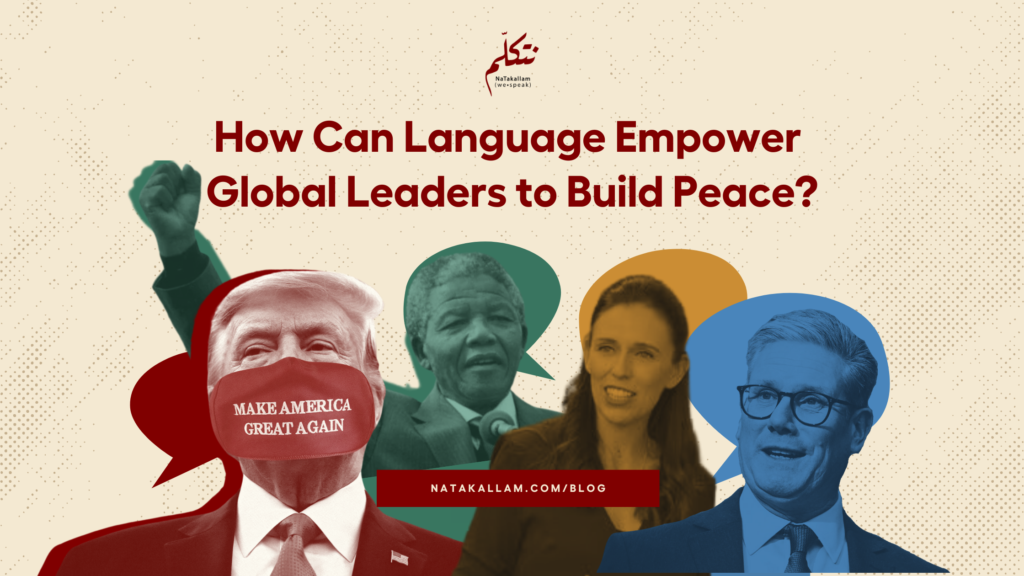
How Can Language Empower Global Leaders To Build Peace?

Language is more than a series of words. Language is a powerful tool for creating dialogue between diverse communities and an invaluable cornerstone of peacebuilding. As the human rights champion and Noble Peace Prize recipient, Nelson Mandela, summed it up, If you talk to a man in a language he understands, that goes to his head. If you talk to him in his own language, that goes to his heart.”


In today’s world, amid new and ongoing conflicts, political leaders and diplomats worldwide face heightened scrutiny. In such a landscape, multilingualism has become more crucial than ever – not just for fostering cross-cultural understanding but as an essential skill for effective communication, negotiation, and peacebuilding in the international arena.


Given the United States’ role on the global stage, one might assume its leaders would lean toward multilingualism. Yet, out of 46 US presidents, only 20 (43%) have spoken a second language.


Meanwhile, some of the most well-known leaders of English-speaking countries – the United Kingdom, Australia, and New Zealand – are monolingual. But, for example, Jacinda Ardern, former New Zealand Prime Minister, wishes she had learned Maori and has promised to raise her daughter speaking the indigenous language.

Some (In)famous Monolingual World Leaders

1. Anthony Albanese (Australia): English

2. Javier Milei (Argentina): Spanish

3. Luiz Inácio Lula da Silva (Brazil): Brazilian Portuguese

4. Xi Jinping (China): Mandarin

5. Christopher Luxon (New Zealand): English 

6. Keir Starmer (UK): English

7. Joe Biden (USA): English

8. Donald Trump (USA): English


Multilingual world leaders are of course not without fault, but let’s take a look at some leaders whose linguistic skills have impacted their roles.

Some Famous Multilingual World Leaders

1. Nelson Mandela (South Africa): English and Afrikaans, also understood several African languages, fostering unity in post-apartheid South Africa.
2. Kofi Annan (Ghana, Former UN Secretary-General)
: English, French, and several African languages, known for his peacekeeping efforts.
3. Angela Merkel (Germany)
: German, English, and Russian, used her language skills to engage in diplomacy across Europe and beyond.
4. Ban Ki-moon (South Korea,
Former UN Secretary-General): Korean and English, with knowledge of French, aiding his global diplomatic initiatives.

5. Queen Máxima (Netherlands): Spanish, Dutch, English, with French, enhancing her role in international engagements.
6. Cyril Ramaphosa (South Africa)
: English, Afrikaans, and several South African languages (including
Tshivenda, Xitsonga, Ndebele, Isizulu, Setswana, Sepedi, and IsiXhosa). This linguistic diversity has been instrumental in promoting inclusivity, enabling him to address different communities directly and address concerns with greater cultural sensitivity.


Studies have shown that learning a foreign language directly correlates to the learner’s ability to empathize with and enhance understanding of the speakers of that language and subsequently, their culture. Multilingualism serves as more than a skill; it is a bridge to better understanding and fosters cross-cultural connection to the benefit of everyone involved.


Imagine the impact if more world leaders were required to be culturally and linguistically competent in a foreign language – and to leverage their multilingual skills for peace, diplomacy, and collaboration across borders.


At NaTakallam, language doesn’t stop at syntax. Whatever languages you speak – or are eager to learn – embrace the role of language in opening doors to new cultures, building empathy, and fostering intercultural competencies. 


With NaTakallam’s experienced language partners, you’re not just learning to speak – you’re delving into the cultural nuances and contexts that define meaningful communication. Each session highlights the importance of language as a tool for understanding, reinforcing how multilingualism can build connections, prevent misunderstandings, and promote peace. This immersive experience empowers you to not only communicate but also appreciate the subtleties that can shape the difference between merely talking and truly connecting across languages, embodying the spirit of multilingualism as a catalyst for dialogue and peacebuilding.


Yalla, vamos, on y va! What are you waiting for? Choose from Arabic, Armenian, English, French, Kurdish, Persian, Spanish, Ukrainian or Russian… and learn a language, the NaTakallam way!

How Can Language Empower Global Leaders To Build Peace? Read More »

loading gif

Available Coupon

X